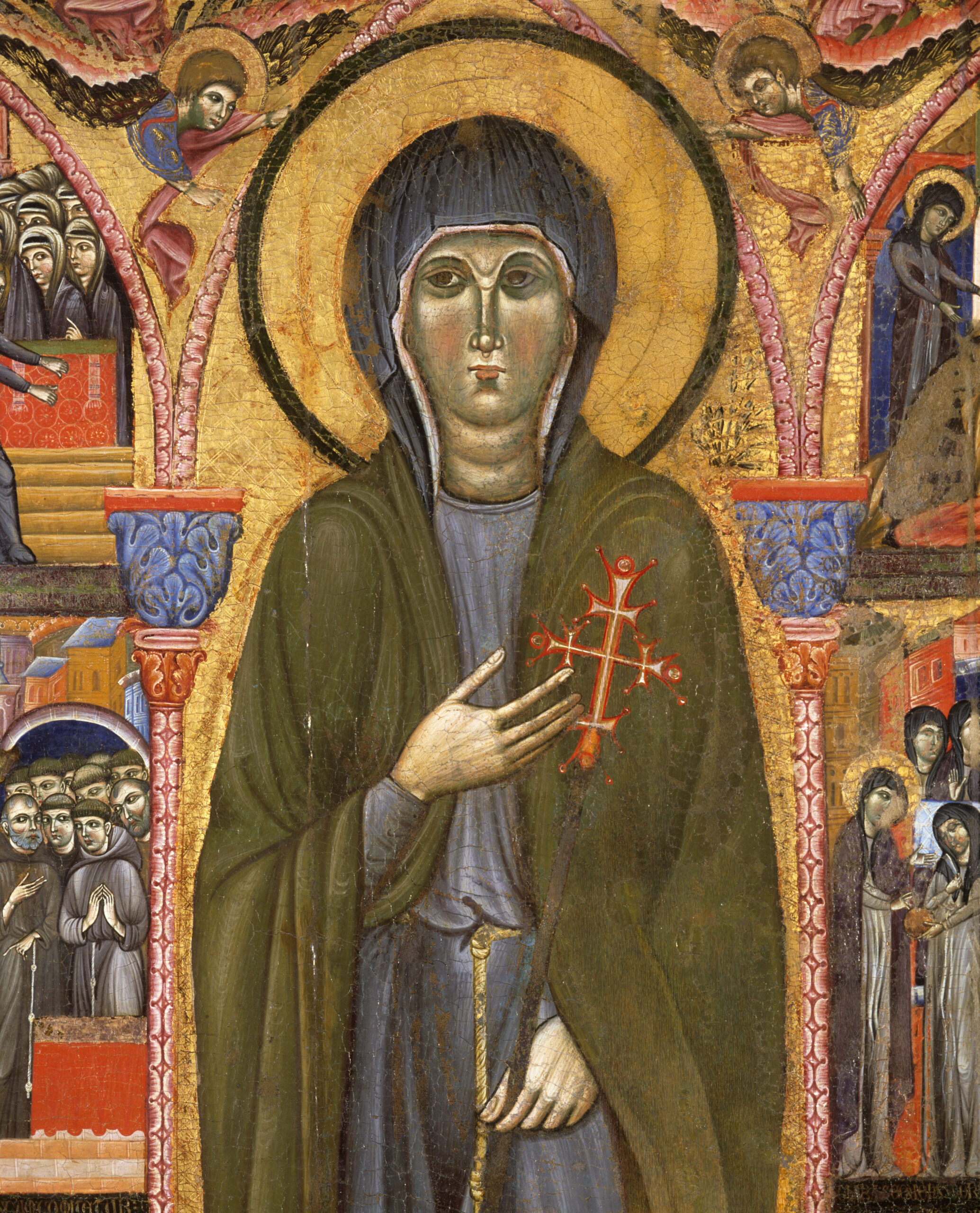
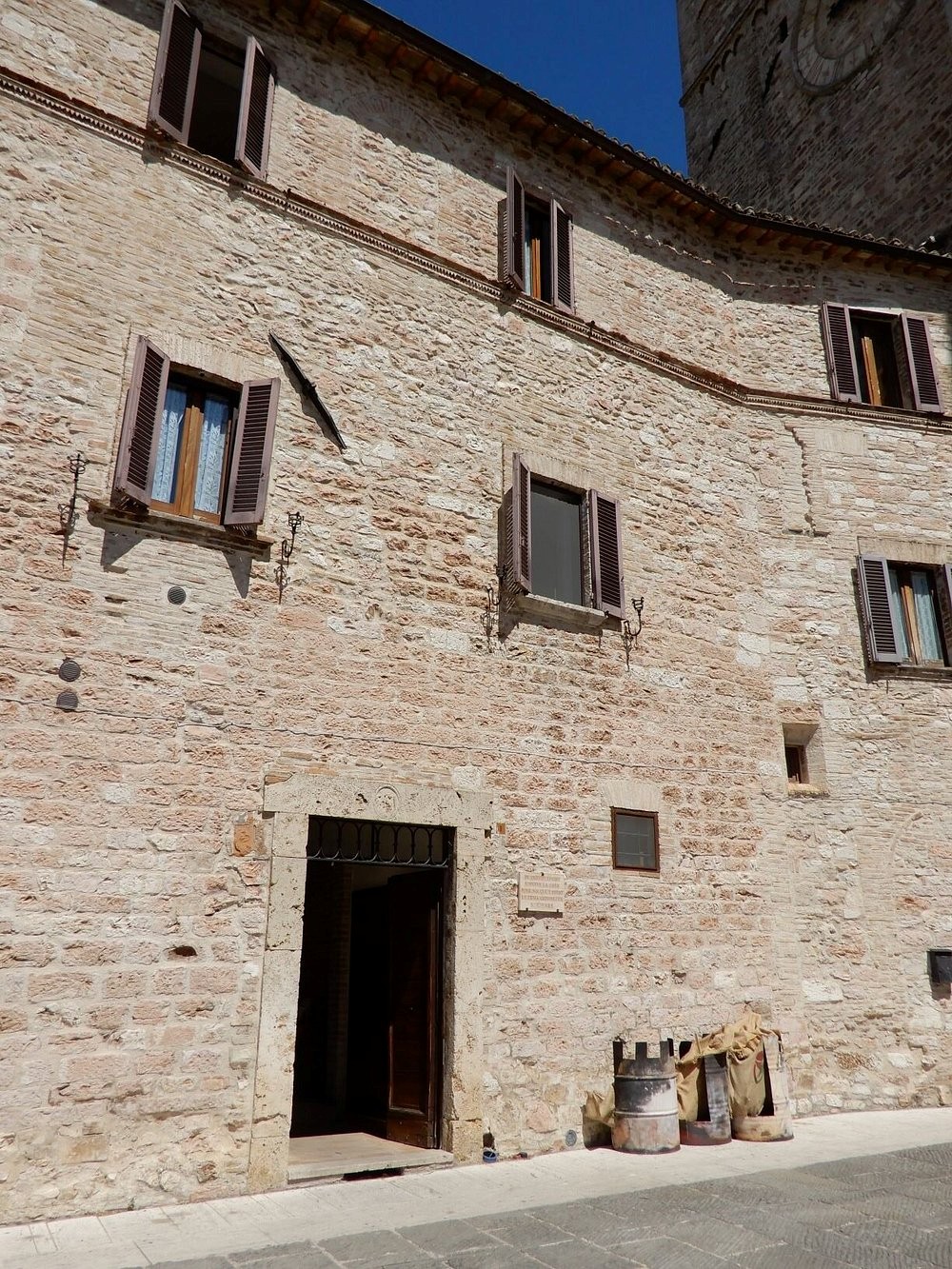
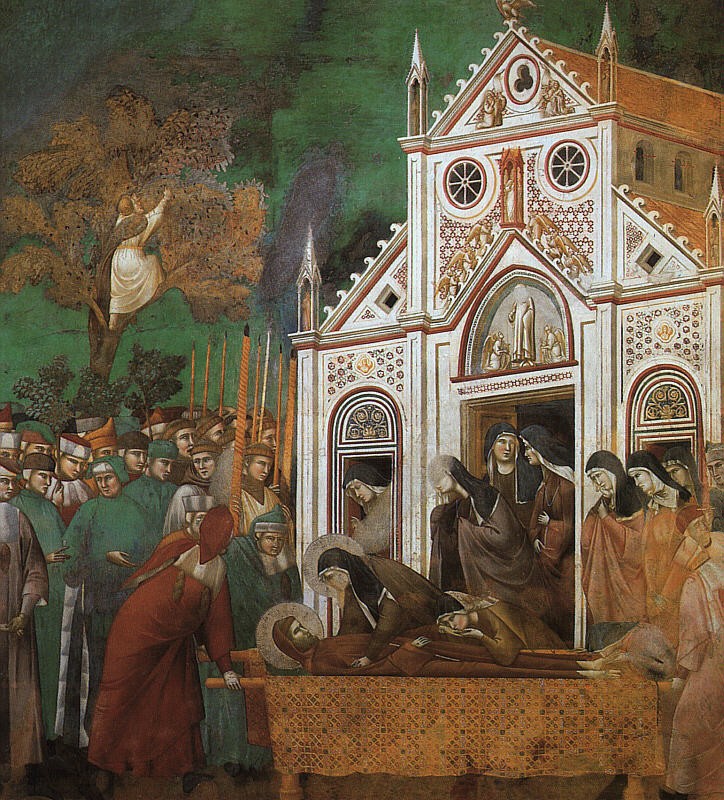
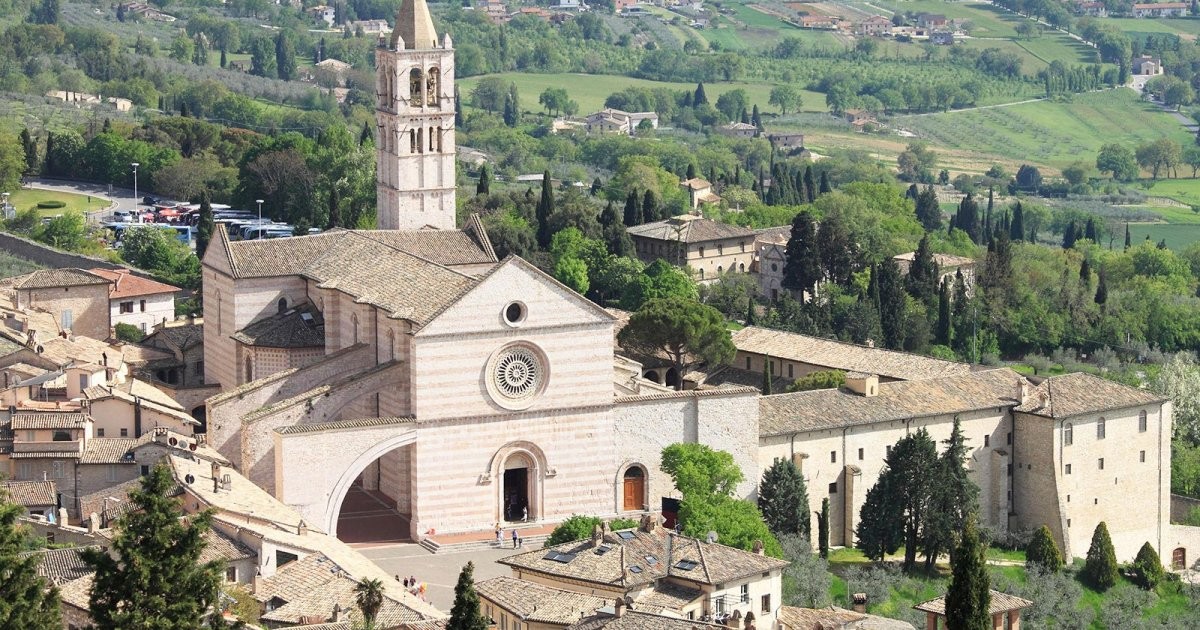
The daughter of Count Favarone Offreduccio and his wife Ortolana Fiumi, Clare was born in a typical noble tower-house and was the eldest of three sisters. Following the uprising of the minores against the maiores—that is, of the bourgeoisie against the nobility—during which the minores, demanding the independence of the city of Assisi, destroyed the fortress and many noble houses, Clare’s family, like many others, moved to Perugia. They returned only years later, when the maiores managed to regain control of the city after the historic Battle of Ponte San Giovanni, in which Francis was taken prisoner. But what was Clare’s life like? As with all aristocratic girls, she had an abundance of fine clothes and jewellery, yet she lived in a kind of ivory tower. The women of the household lived apart from the men, in rooms reserved exclusively for them. They were not allowed to go out except to attend religious functions, nor even to look out of the windows, so as to protect their reputation. They knew of life only through the reading of chivalric romances, the Gospels, the lives of the Saints, and the occasional story told by the servants. Their future held two possibilities: marriage or the convent. Girls were generally taught the domestic skills expected of a good wife, but were also instructed in reading and writing, both in Latin and in the vernacular. Clare’s fate, then, seemed decided: she was to marry a knight to ensure a useful alliance for the Offreduccio family. Yet, even during the family’s exile in Perugia, she had begun to dedicate herself to charitable acts for the poor. Once back in Assisi in 1205, she often wore coarse garments beneath her fine dresses, wishing to share the condition of the poor. Poverty—and its effects within the Catholic Church—was a subject Clare knew well, for news of what was happening in Italy and across Europe had reached her. She certainly knew of the Cathars, the Waldensians, and the Patarines, who, though condemned as heretics by the Church, demanded a life more in accordance with the Gospel. A major influence on Clare’s formation was her mother, Ortolana Fiumi. Descended from an aristocratic family, Ortolana was not confined to a life of seclusion within the family apartments: she had undertaken pilgrimages to the Holy Land, to Rome, and to Santiago de Compostela, accompanied by friends and neighbours. She was a devout yet enterprising woman. As she grew older, Clare felt an ever-stronger desire to live in poverty and according to the Gospel, though she did not yet know how to fulfil this calling. The turning point came with her encounter with Francis. Clare had heard of him and his penitents, and it was her friend Bona di Guelfuccio who arranged their first meetings. The women attended these gatherings secretly, seeking spiritual guidance. Clare found in Francis the encouragement to renounce everything and dedicate herself entirely to Christ. Clare abandoned her aristocratic life on Palm Sunday in 1211. She attended Mass in her finest clothes to avoid suspicion, but that night she secretly opened a back door of her family’s tower and left her home. She made her way to the gates of Assisi, where Francis and a few of his companions awaited her. She was eighteen years old. Her conversion was marked by a simple yet symbolic rite: after the reading of the Holy Week Gospel, Clare removed her elegant garments, put on a humble woollen habit, and offered her head to Francis, who cut off her long blond hair. That very night, Francis took her to the Benedictine convent of San Paolo delle Abbadesse, which enjoyed the papal right of asylum granted by Pope Innocent III. This dissuaded her relatives, who came to reclaim her but left when Clare resolutely refused to return home. After a few days at San Paolo, where most of the nuns were of noble birth, Clare was moved to the church of Sant’Angelo in Panzo, inhabited by a small group of women hermits. In the days of silence and prayer that followed, Clare conceived her final vision of the community she wished to found. She did not want to live in isolation, for that would prevent the practice of “fraternity” as experienced by the Friars Minor, nor did she want strict enclosure, which would have barred her from living in poverty. Monasteries, sustained by dowries and Church endowments, often led comfortable lives, which was contrary to her ideal. Her idea of community was therefore very similar to that of the Friars Minor. It took concrete form when she was joined by her sister Caterina, who took the name Agnes, and by Pacifica, the sister of her friend Bona di Guelfuccio. Together they founded a contemplative community without individual isolation, believing that such separation would hinder spiritual dialogue. They aimed to mirror God in their lives and in each other, living above all in poverty. When Francis judged that Clare and her companions were ready, he led them to San Damiano. The first community founded by Clare was family-like in structure: alongside her were her sister Caterina, her friend Pacifica, later joined by other friends and cousins, her younger sister Beatrice, and finally her mother Ortolana, who had become a widow. At San Damiano, the community gathered around the small hermitage that Francis had restored. Beside their dwelling was that of the friars, who, according to custom, were to provide material and spiritual assistance to the sisters. The small group lived according to the Franciscan way of life, without seeking ecclesiastical approval or formal ties to the male order. They survived on alms, and among them there was no hierarchy based on class or education. Clare accepted the role of abbess only out of obedience to Francis, who, being constantly engaged in preaching, could no longer oversee the Damianite sisters. Their poverty was evident in the humble wooden and straw dwellings with unstable walls in which they lived. The Order of the Poor Ladies embodied a form of life that blended the cenobitic and eremitical models, infused with Franciscan spirituality. In their daily lives, Clare and her sisters practised great austerity, alternating prayer and penance. According to contemporary accounts, Clare was exceedingly severe with herself: she fasted three times a week and ate very little. Beneath her wool tunic and cloak, she wore a coarse hair-shirt made from pigskin or horsehair as a form of penance. She was humble and self-sacrificing, caring tenderly for her sisters. The community of San Damiano soon became renowned, and other similar foundations arose in Florence, Lucca, and Siena. However, the Church, fearing heresy and lacking control over these independent communities, convened a council which decreed that all mulieres religiosae must adopt a formal rule and depend on the Holy See for their sustenance. To avoid dissolution, the San Damiano community had to adopt a recognised rule, and thus affiliated itself with the Benedictine Order. This, however, conflicted with one of the fundamental principles of the Damianites: poverty. Benedictine convents, being enclosed, were required to possess property for their maintenance, whereas Clare’s sisters lived solely on alms. Clare therefore petitioned the Pope for what became known as the “Privilege of Poverty,” which she was eventually granted. Yet challenges to her ideal persisted. Cardinal Ugolino—later Pope Gregory IX—drafted the Ugolinian Constitutions, introducing incompatible reforms. For instance, women’s communities near cities were to be strictly enclosed: they were forbidden from being seen, their windows and openings were to be barred and covered with black curtains, and they were prohibited from speaking or listening to outsiders. This contradicted Clare’s belief in spiritual dialogue and active engagement. Moreover, the new rules re-established class hierarchies between noble and servant sisters. Faced with these changes, the Damianites resisted. Francis, returning early from the Holy Land, encouraged them to remain steadfast in their commitment to Christ’s poverty. When Cardinal Ugolino visited San Damiano, he realised that the community was unlike any other convent built by wealthy ladies. These women, who had chosen poverty not to hide from the world but to transform it through example, deeply impressed him. As Pope Gregory IX, he reaffirmed their Privilege of Poverty. After Francis’s death, the divide between the Friars Minor and the women’s communities widened, as many friars now supported strict enclosure, while Clare and her sisters continued to reject it. Only a few of Francis’s earliest companions continued to defend the Damianite ideal. Pope Innocent IV eventually imposed full enclosure, property ownership, and the abolition of the Privilege of Poverty. Sensing her end was near and unwilling to leave her sisters without a guiding rule, Clare decided to write it herself. The essential elements of her Rule concerned a way of life based on obedience, poverty, and chastity; the abbess’s role as a democratic leader who shared fully in the sisters’ life; the strict observance of poverty by all; a form of enclosure that was flexible, permitting departure for useful and reasonable causes; the absence of hierarchy within the community; and the encouragement of manual work after spiritual duties, under the abbess’s guidance. Pope Alexander IV, formerly Cardinal Rainaldo and long a protector of the community, confirmed Clare’s Rule with a papal bull, which reached San Damiano as Clare lay on her deathbed, on 11 August 1253. The process of her canonisation began immediately after her death, supported by the testimonies of her sisters at San Damiano, who recounted miraculous events from her life—hence her traditional iconographic symbols: the monstrance and the pastoral staff.