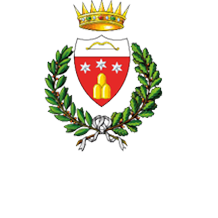
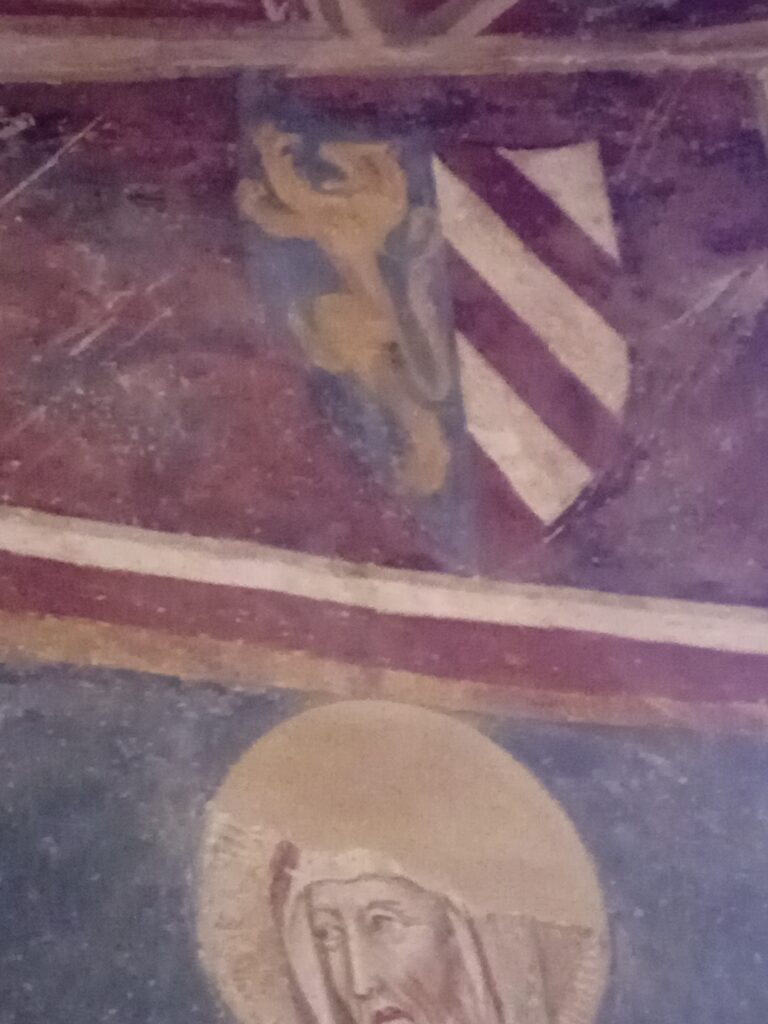
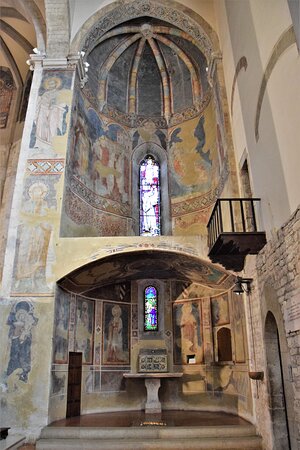
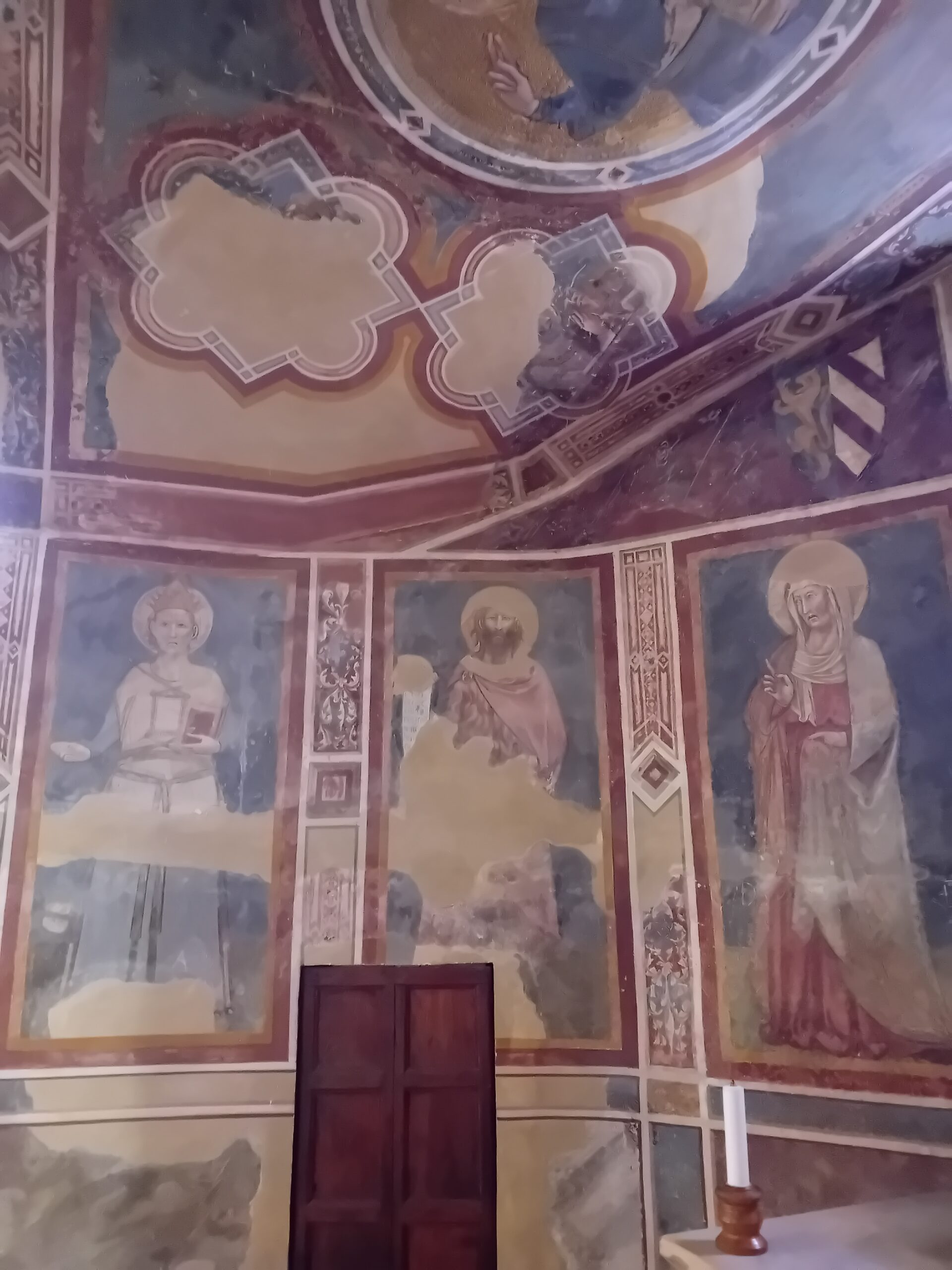
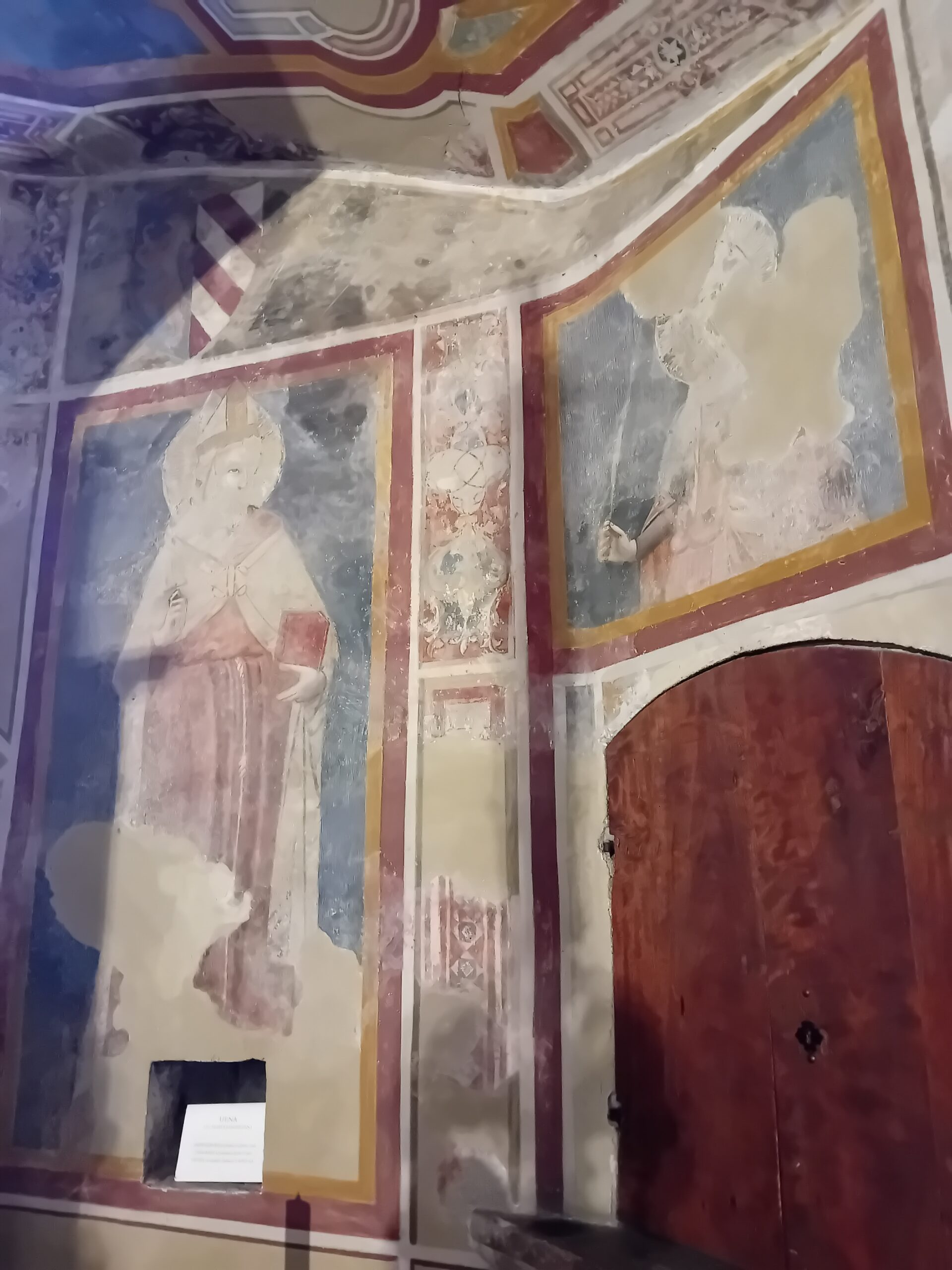
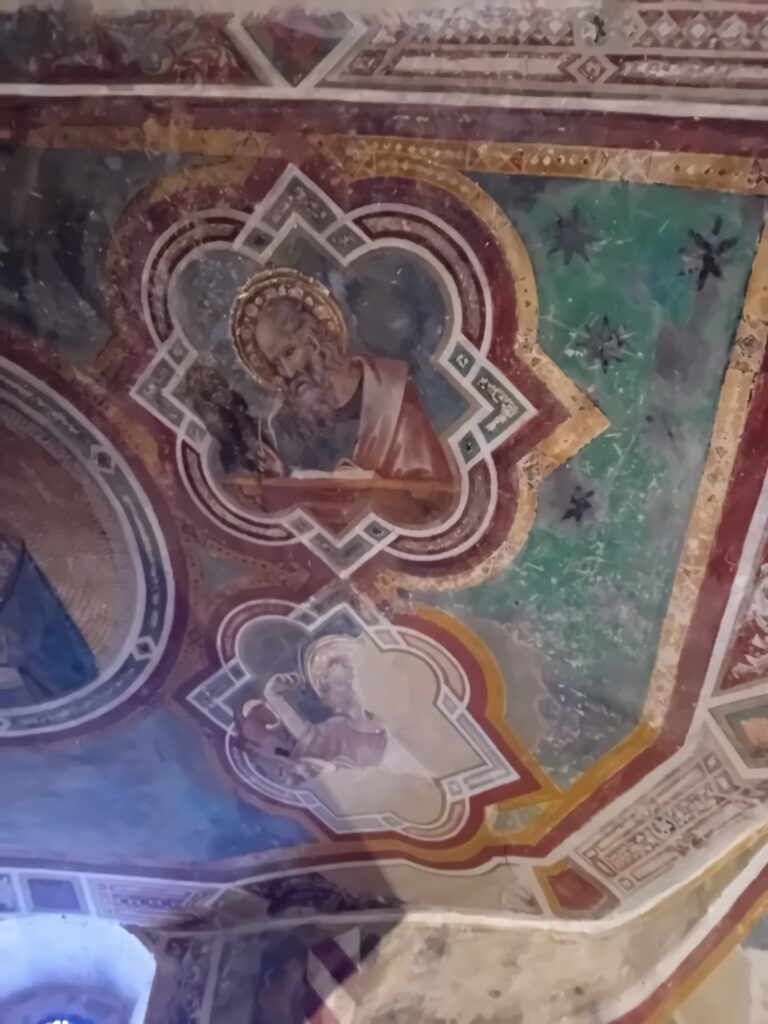
Gubbio, in its annals, recounts the story of an illustrious lineage linked to the history of the Templars: the Sforzolini. Baptista Sforzolini was an intrepid knight and a dedicated Templar—whether Gierosolimitano or Giovannita (interpretations vary)—noted as the knight of Rhodes, Gudio Sforzolino, and also mentioned by the distinguished ecclesiastical historian Bonaventura Tondi. Within the Church of San Francesco in Gubbio, situated in Piazza 40 Martiri, the former Market Square, stands the Sforzolini Chapel. It is located near the sacristy, which during Francesco’s time housed the family Spadalonga’s shop, known for welcoming the Poverello, providing him with food and clothing. The Sforzolini Chapel bears the coat of arms of this noble family: according to heraldic tradition, a golden rampant lion on a blue field on one side, and on the other, three red diagonals on a white background.
Today, visitors to this chapel—adorned with frescoes by the expressionist master of Santa Chiara—can also see the urns of the blessed Franciscan figures: Bartolomeo da Gubbio (died 1236), Tommaso da Gubbio (died 1334), and Pietro da Gualdo Tadino (passed away in 1367). Regarding the knightly orders and their presence in Gubbio, it is worth noting, as an aside, that Andrea di Ludovico from Gubbio —remarkably, but unjustly forgotten—served as the Grand Master of the Order of the Crociferi in 1430.
Turning back to the Sforzolini family, the earliest known ancestor is Forzolo, who lived in 1237. His son, Buonagiunta, born in 1258, fathered Uguccio, who in turn was the father of Forzolo (bearing the same name as his grandfather, as was customary). This Forzolo was the parent of Niccolò, captain of the castle of Baccaresca in 1389, and of the renowned Ser Guerriero, who, in his “Chronicle,” recounts his role as Gonfaloniere during the presentation to Antonio da Montefeltro seeking submission from the city of Gubbio (he “had the seal,” as Ser Guerriero writes). Niccolò’s grandson, Gioacchino, born in 1418, authored the Florentine Statutes. In 1447, Giambattista was born; he was a Knight of Jerusalem and, in 1482, served as “Ambassador to Duke Guido Ubaldo I,” as recorded in the family’s genealogical tree kept at the Franciscan Library of Gubbio. Eugenio Gamurrini (1620–1692), Benedictine monk and historian, in his monumental “Historical Genealogy of Noble Tuscan and Umbrian Families” (Vol. 6, Florence, 1641), emphasises the Umbrian-Tuscan origin of the Sforzolini, specifically at the border between the two regions.
In Lucarelli’s “Memory and Historical Guide to Gubbio,” the heirs of the Sforzolini are identified as the Scassellati of Gualdo Tadino, among whom was Antonio, a researcher and scholar of popular culture, who authored a notable manuscript attached to a letter sent from Gualdo Tadino on 7 February 1900, now preserved in the Giuseppe Bellucci Archive of Perugia (Box: Scassellati Sforzolini, Folder 1, Page 8, unnumbered). This document offers a fascinating dive into the folkloric and superstitious heritage of the agrarian -pastoral culture: “The stable must be lined with marten fur, to ward off envy. This should also be on the ropes of the manger and all exposed parts. For woolly animals and pigs, red tassels against the evil eye; red tassels and marten fur when taking animals to market.” The family’s interest in popular culture and esotericism appears to have been a notable trait, as a documentary account from 16 July 1611 recounts that Polidoro Sforzolini, leaving the Church of San Domenico, was arrested by the “bobbies” and taken to Urbino prison on charges of dealing with alchemy-related matters. The nobleman was released on 18 July, as no convincing evidence was found against him, thanks also to the intervention of Giulio Scorcelli, his brother-in-law, since Polidoro had married his sister Artemisia.
Another document, dated 3 June 1768, reports that the city’s Constable, Camillo Antonucci, had Marco Minelli released from prison; Minelli was accused of theft of garlic from Domenico Sforzolini.