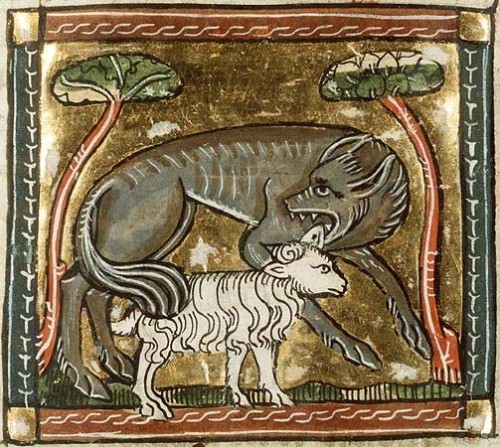
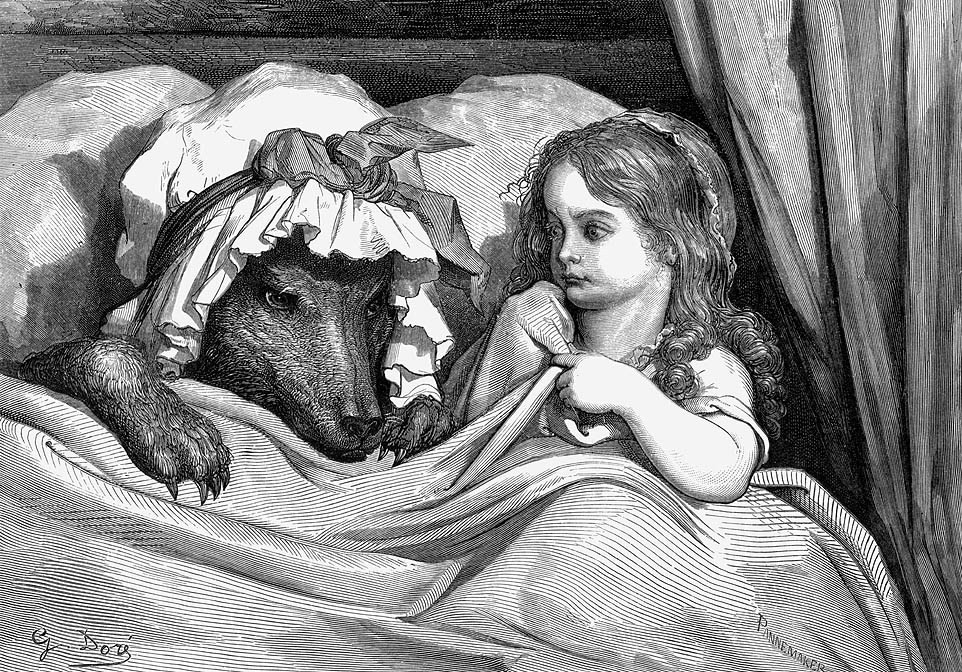
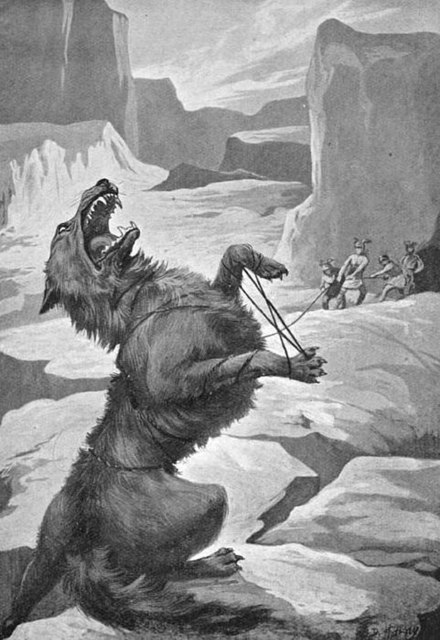

The story of the wolf is not solely an ecological narrative; it also possesses a profound social and cultural significance rooted in the relationship between the animal and humans, as well as in the collective imagery that humans develop from this relationship. In this discussion, we will focus on this latter aspect. Certainly, the social and cultural history of the wolf depends on the ecological context and the often profound changes that humans have inflicted upon its ecosystem. During the Middle Ages, at least until the 10th century, Europe was characterised by vast forests covering much of the territory of various states. In these environments, wolves had ample prey and refuges, and there was no need for them to venture beyond the forest boundaries. Consequently, there were no significant issues of coexistence with humans. However, from around the year 1000, the situation changed. Under the reign of Charlemagne, human pressure on the environment intensified; the forests preferred by the king and his court for hunting were to be cleared of wolves. Measures were implemented to safeguard the game stock of the aristocratic forests of the Frankish realm, including legislative decrees issued by the emperor and his successors. Charlemagne demanded continuous reports on the number of wolves killed within his domains and mandated that wolf hunters be appointed throughout the empire. Although the Edict of Rotarius in 643 also referenced wolf hunting, it did not pose a deadly threat that would justify state intervention. The wolf’s situation worsened further in subsequent centuries due to systematic attacks on its habitat. Starting from the 12th century, Europe experienced an economic boom, and the expanding oak forests—essential for the free-range raising of pigs—were among the first to suffer. Destructive deforestation occurred, and the remaining forests were modified to meet human needs. Cultivated woods appeared, where certain tree species, such as chestnuts, were either replaced or enhanced for timber and food production. Additionally, houses were built within these forests to accommodate woodcutters and farmers. This was a fundamental shift: forests were reduced in size and populated by humans, permanently altering the history of the European wolf. The wolf had to adapt by leaving the woods to seek food near human dwellings and among livestock. It was during this period that reports of attacks on humans increased, as deforestation and the scarcity of game left domesticated animals as the only available prey. Such developments fostered the myth of the “bad wolf” and marked the beginning of a slaughter that would eventually eradicate the wolf from much of Europe. From the 13th century onward, and especially in the 15th century, laws were enacted in towns and regions targeting wolves, which increased in number as deforestation continued. As Riccardo Rao observes, mankind was mistaken twice in this regard: not only did humans reduce vital ecological spaces, but they also eliminated a species crucial for maintaining the ecological balance. Since the year 1000, in Europe, the wolf has been increasingly portrayed in a negative light—as a ravenous, fierce creature, symbolising evil. This was not always the case. When rural populations lived closely with forests, the wolf was almost a familiar presence. For instance, in early medieval Europe, wolf names were common in personal onomastics, especially in Northern Europe. The most notable example is Beowulf, the hero of the Old English epic poem from the 8th century. Etymologically derived names from the word “wulf” (wolf) appeared among many barbarian peoples of Western Europe between the 4th and 6th centuries—such as Wulfila, Ataulfo, Achiulfo, Vultulfo, and Ediulfo. The name “Wolf” was given to boys in the hope that they would acquire wolf-like skills and strength, inspiring respect and fear. The image of the wolf has not always been negative. For example, in the “Roman de Renart” of the 12th-13th centuries, Ysengrin, the wolf antagonist of the fox, is depicted as a comic sidekick. His traits include greed, arrogance, and foolishness—characteristics that have come to define the wolves portrayed in fairy tales and comics, such as Ezekiel the wolf in “The Three Little Pigs”. Ysengrin is described as a violent and foolish animal because, by the late Middle Ages, the ecological and cultural value of the wolf was no longer recognised. The wolf was no longer feared, having been drastically reduced through centuries of persecution, and the medieval Christian worldview cast it as inferior and demonic—an image reinforced by biblical texts, patristic writings, and Christian literature of the early medieval period. These sources shaped the figure of the “bad wolf,” which was not just a predator of flocks but also a threat to souls and faith. Fear of the wolf thus became intertwined with the fear of sin. In Norse sagas, on the other hand, wolves play a role in cosmogony. In the “Edda,” the most famous Old Norse text, despite Christian influences, wolves govern the cycle of celestial bodies.