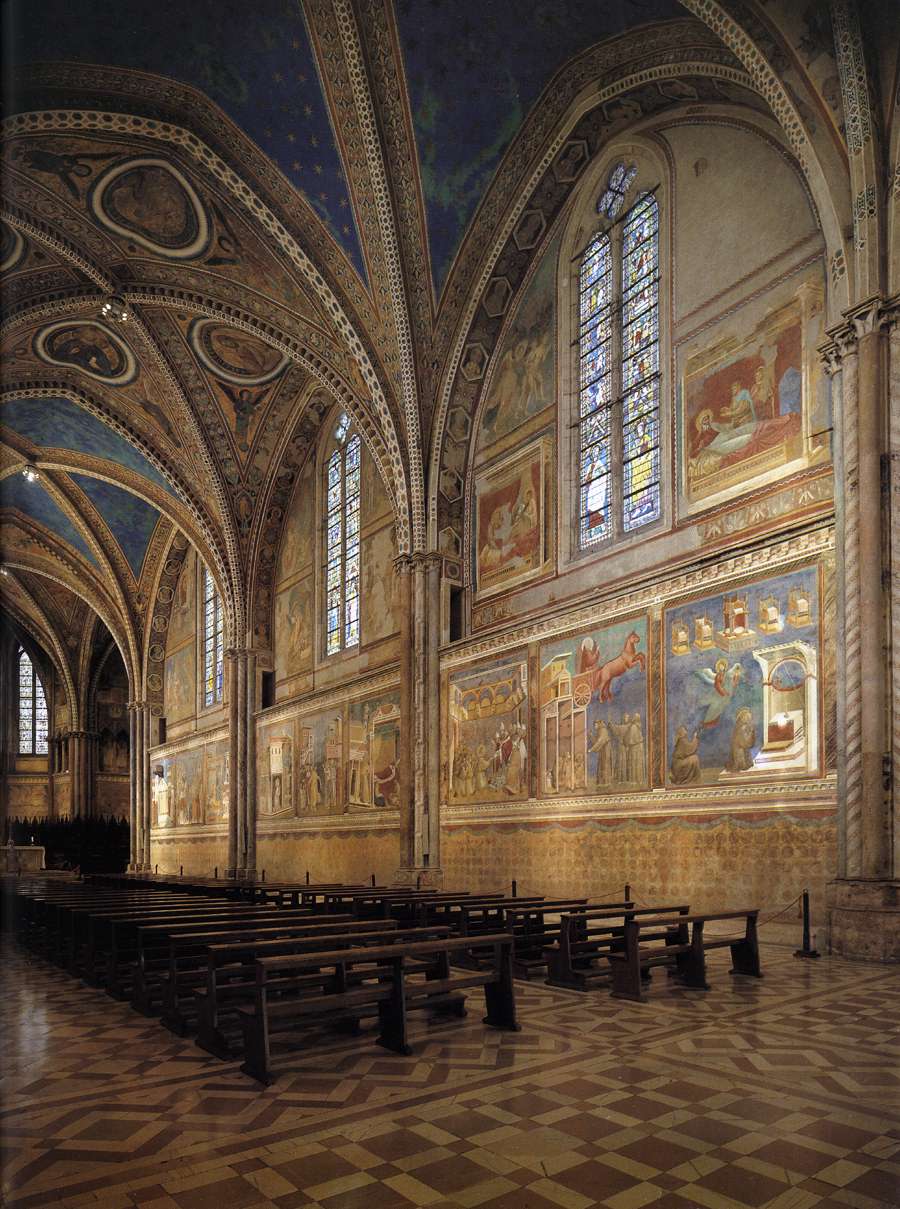
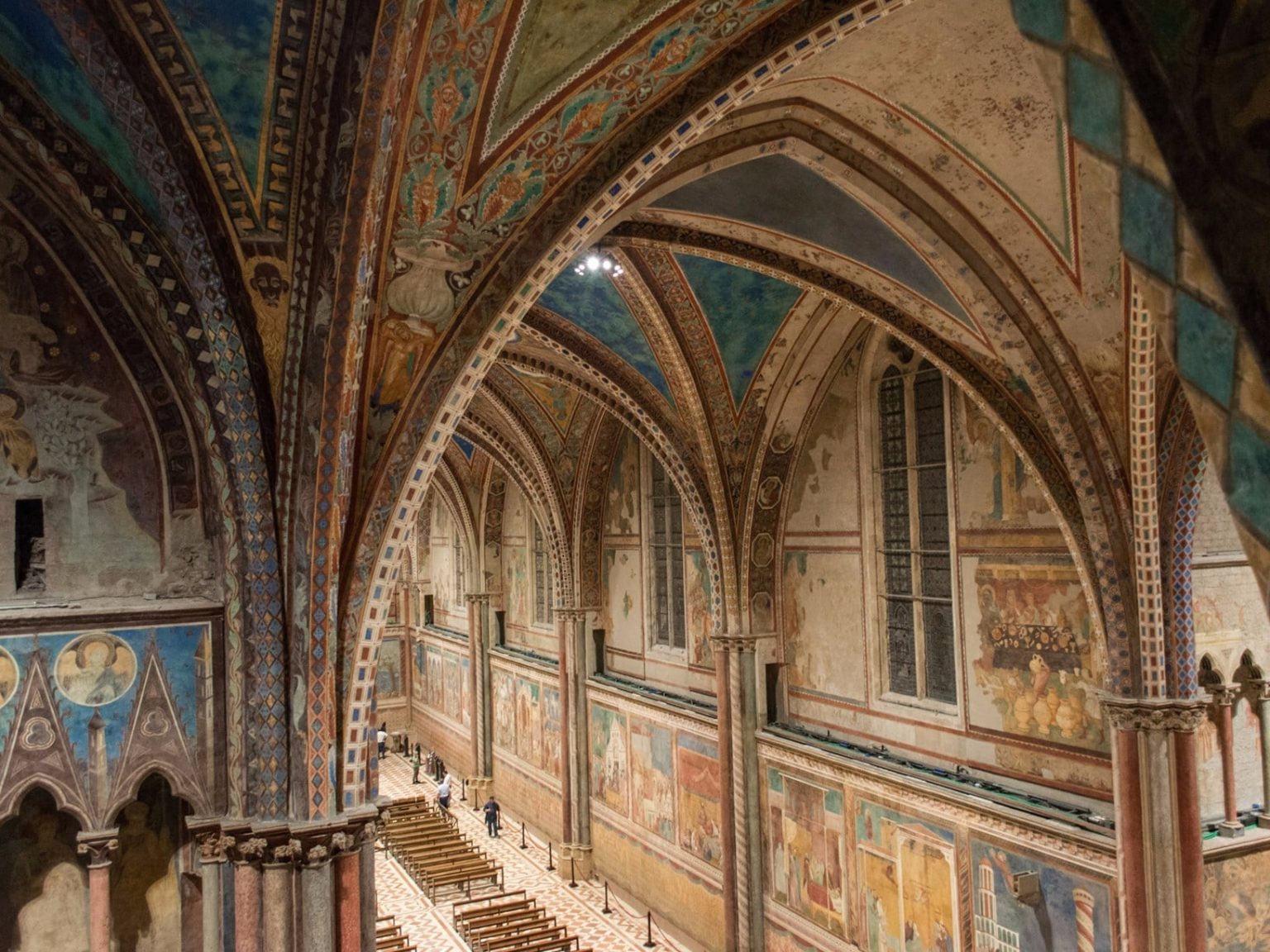
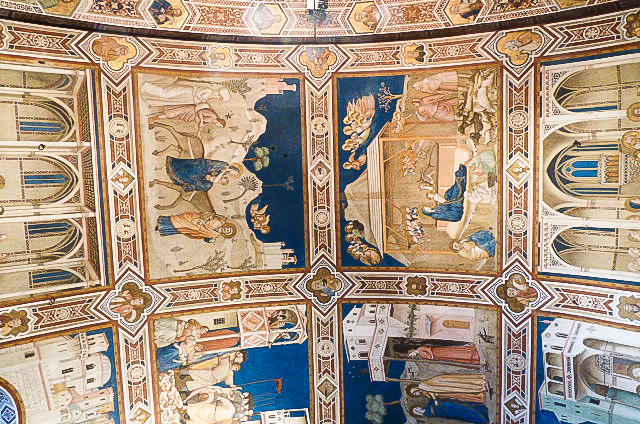
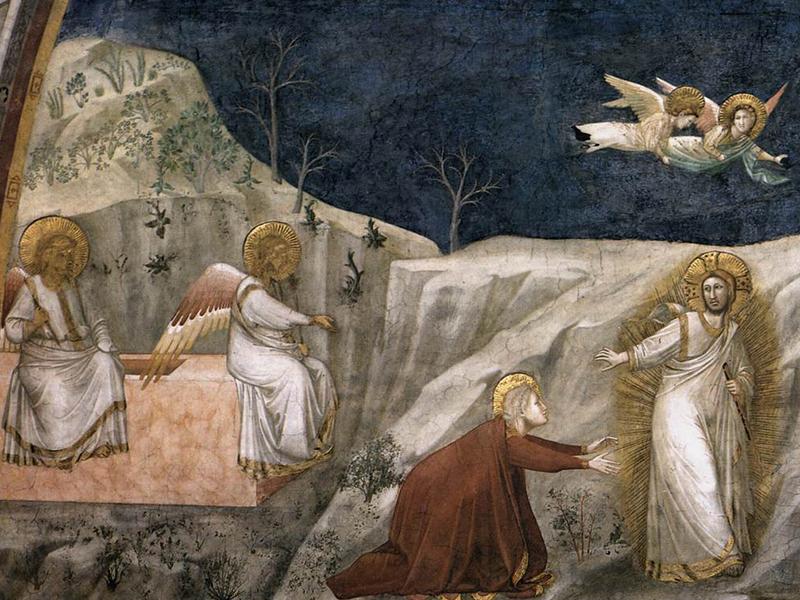
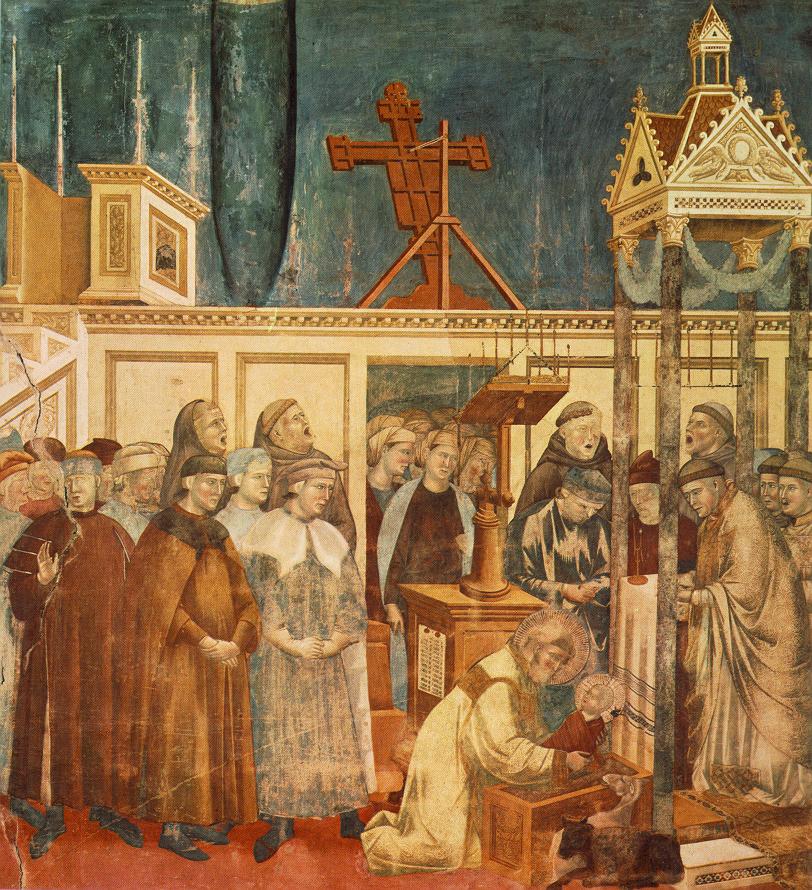
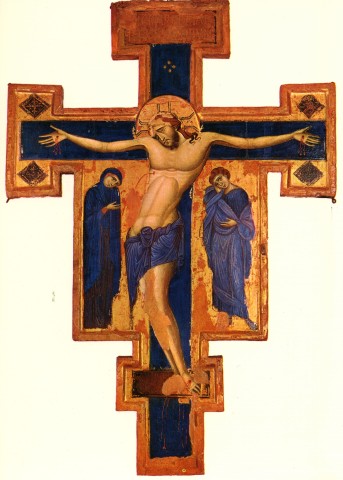
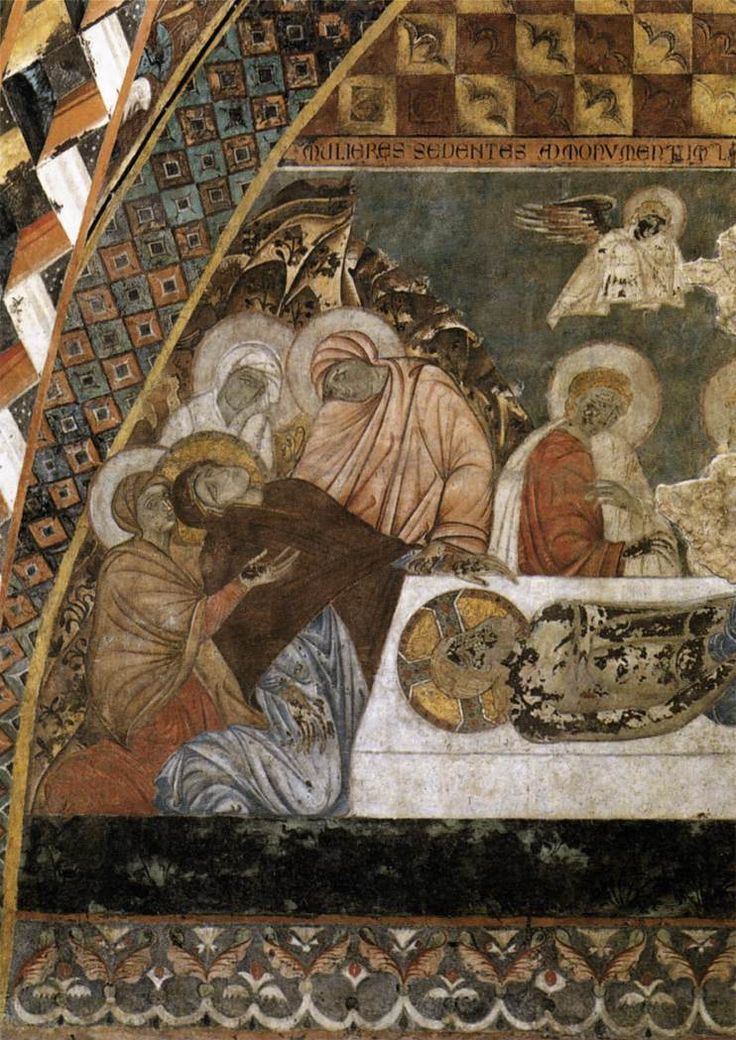
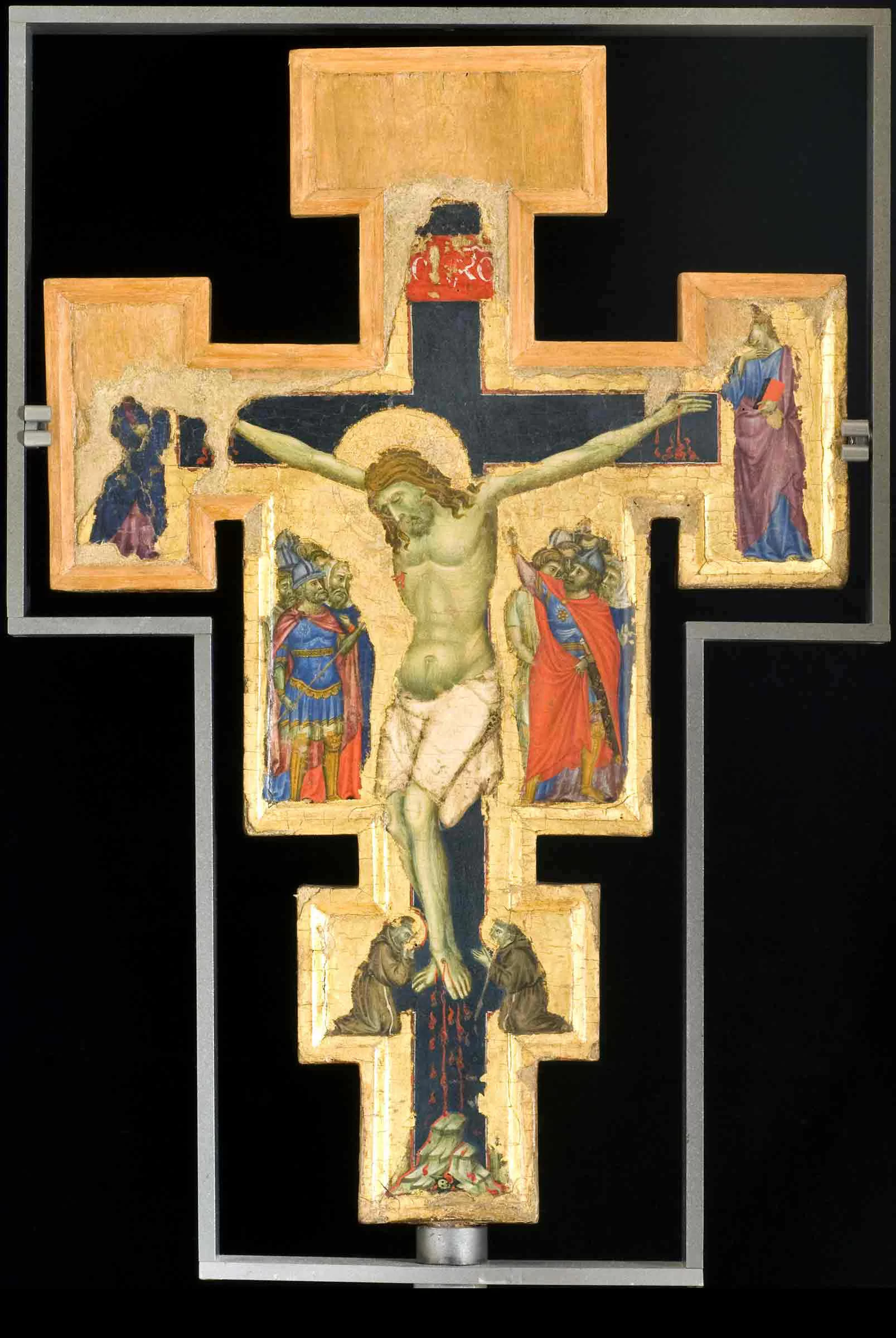
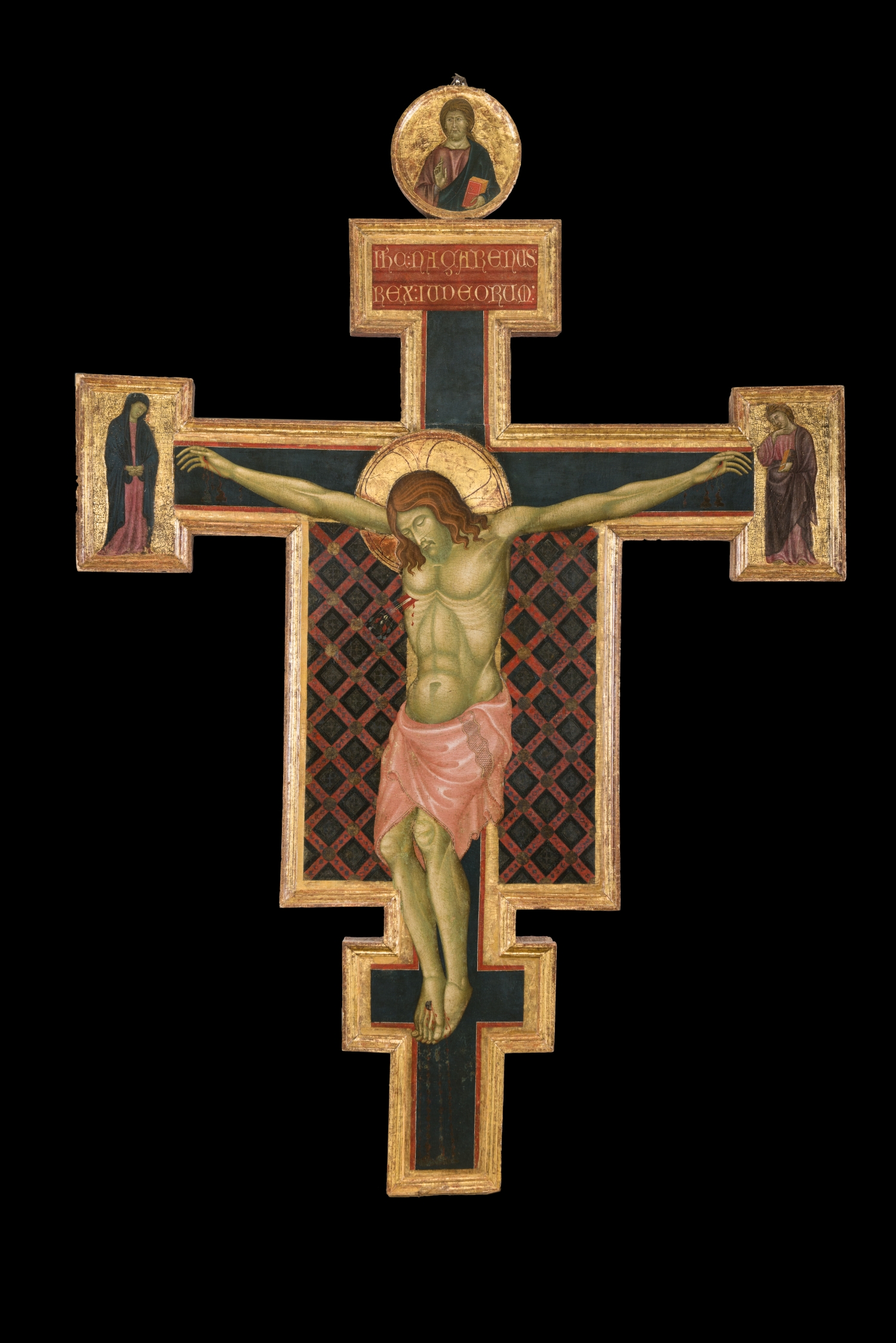
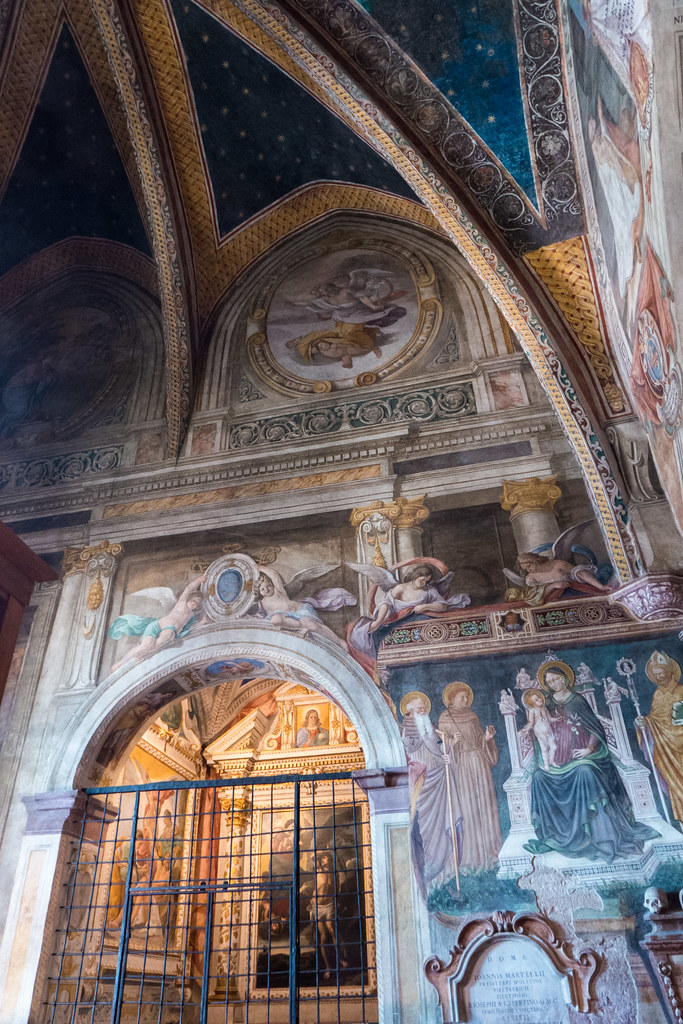
Five generations of artists from Gubbio were active in Assisi between the thirteenth and fifteenth centuries, working on what was the largest medieval workshop in Europe. They collaborated with the master craftsmen engaged in decorating the Basilica of Saint Francis, eventually becoming themselves agents of dissemination for new artistic languages. The artists from Gubbio proved to be reliable, as they demonstrated a high receptiveness to stylistic and technical innovations. Their presence was also influenced by their origin from a Guelph city allied with the Papal States. The first significant presence was that of the Master of the Franciscan Crucifixes, whose true name is believed—by some scholars—to be Guido di Pietro da Gubbio, possibly the father of the renowned Oderisi, the ‘honour of Agobio’ celebrated by Dante Alighieri in the Divine Comedy, in the eleventh canto of Purgatorio, as one of the most skilled miniaturists of his time. The painter trained around the mid-thirteenth century in Umbria, participating in the early decorative phase of the Assisi Basilica, led by Giunta Pisano, the outstanding figure in Italian painting of the 1200s, preceding Cimabue’s activity. At that time, the prevailing painting style was the ‘Byzantine’ style, originating from the Near East, characterised by a lack of volume and depth but marked by refinement and elegance. This style was perfectly suited to symbolically representing sacred images, capturing their essence and mystery. In the lower basilica, the anonymous master from Gubbio would have executed the Passion Stories on the northern walls of the nave and painted two Crucifixes for the altars, now preserved at the Museum of the Treasury in the Sacred Convent of Assisi and at the Museum of Cologne. During that period, painted crosses were among the most sought-after panel works. They were not intended for altars but hung at the top of the iconostasis or in the apse, as evidenced by certain details in the paintings within the Assisi Basilica. The Crucifixes painted by the Master of the Franciscan Crucifixes depict the Christus Patiens—the Suffering Christ—with closed eyes, a sorrowful expression, head inclined, and body curved on the cross. This humanised model of Christ was disseminated in Umbria through a lost cross attributed to Giunta Pisano, originally made for the upper basilica. Beyond stylistic and iconographic innovations, the artists in Assisi also witnessed and participated in the development of new artistic techniques (such as stained glass art) and the refinement of existing ones. The most revolutionary change was in wall painting, which from the mid-thirteenth century onwards was no longer executed in secco (dry plaster), but instead with buon fresco, applying colours directly onto fresh, damp plaster. Until the late 1200s, frescoes were painted ‘a pontate’—meaning the artist painted a section of plaster as long as the scaffolding used, moving the scaffolding to the next segment once completed. This method followed a horizontal workflow and required swift execution, as the painting had to be finished before the plaster dried. Consequently, this quick, spontaneous style resulted in depictions that were often less detailed and precise, with many elements added later ‘a secco’. From the end of the thirteenth century, to achieve more detailed and realistic representations—especially of human figures—the technique shifted to ‘a giornata’, whereby the artist painted a section of plaster that dried within a day. While blue appears to have been the preferred colour of the Master of the Franciscan Crucifixes in panel paintings, red was certainly prominent in many works by the Master of the Gubbio Crucifix. The latter was active between the late thirteenth and early fourteenth centuries in Gubbio and other Umbrian centres, operating a flourishing workshop specialised in painted crosses, Maestà, and Madonna and Child enthroned images, executed in fresco or tempera on panel. His eclectic style matured within the workshop of the upper basilica of Assisi, influenced initially by Cimabue style and Roman masters, and later by the young Giotto. In Assisi, masters from Gubbio would have worked as an assistant in the fresco decorations of the northern wall, both in the New Testament scenes on the upper level and in the Franciscan stories on the lower level. There is a strong resemblance in decorative motifs, facial features of some characters, and overall environmental details among these Assisi frescoes and other works by the master from Gubbio, such as the double-sided Cross in the National Gallery of Umbria and the Madonna and Child panel from the church of San Damiano in Assisi. The conventional name of this master derives from the painted Cross now housed at the Civic Museum in Palazzo dei Consoli. It depicts the Suffering Christ in a manner characteristic of Giotto, with a human and modern approach. The inspiration is likely the work created by Giotto for the church of Santa Maria Novella in Florence, or perhaps a lost example painted by the Tuscan master for the same Franciscan Basilica in Assisi. The most important pupil and collaborator of Giotto in the Assisi Basilica workshop was Palmerino di Guido, also from Gubbio. Known publicly as the Maestro Espressionista di Santa Chiara, he was active from the late thirteenth century until the late 1330s, mainly between Gubbio and Assisi. After beginning with the Franciscan Stories on the southern wall of the upper basilica, likely working under the guidance of the Master of the Cross, he assisted Giotto in creating the Stories of Mary Magdalene, the Stories of Christ, and the Stories of Saint Martin in the lower basilica. Thanks to this collaboration, Palmerino di Guido gained recognition within the Franciscan Order, securing important commissions such as the Stories of Saint Clare for the church dedicated to her in Assisi, which earned him the nickname ‘ Maestro Espressionista’. His interpretation of Giotto’s naturalism adopted a more cordial and popular language, with patetic and sentimental overtones, reflecting the devotional needs expressed by Franciscan spirituality. During the years when the Maestro Espressionista executed frescoes in the lower basilica, other masters active there included Pietro Lorenzetti and Simone Martini. The Sienese masters influenced the figurative language of the Maestro Espressionista during the latter phase of his career, following his return to Gubbio. The works produced in his hometown helped spread the refined Sienese Gothic style characteristic of the Gubbio school in the early fourteenth century, alongside the workshops of Guido Palmerucci (his son) and Mello da Gubbio. The grand chapter of fourteenth-century decoration in the Assisi workshop culminated in the Chapel of Saint Catherine, where Egidio Albornoz, the powerful Spanish cardinal sent to Italy by Pope Innocent VI to bring rebellious cities of the Patrimony of Saint Peter back under the Church’s control, was briefly buried. Albornoz financed a chapel restoration in 1362, designed by the architect from Gubbio Matteo di Giovannello, known as il Gattapone, and painted by the Bolognese painter Angelo de Bartoli. Finally, in 1422, the renowned painter from Gubbio Ottaviano Nelli entered the lower basilica, contributing artistically to the place that housed the sacred relics of Saint Francis. His notable work is the fresco depicting the Madonna enthroned with the Child between Saint Francis, Saint Anthony Abbot and Saint Rufino. Known as the Madonna della Salute, this piece is executed in a perfect Florentine Gothic style and is located on the left side of the entrance bay, next to the Chapel of Saint Sebastian.