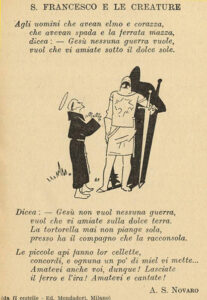
Franciscan spirituality could not help but draw inspiration from the example of Saint Francis himself, even in the realms of lyric, poetic, and musical expression. The Saint, during his pilgrimage, extensively drew upon the troubadour and chivalric traditions: before embarking on the path of conversion and religious testimony—made luminous and compelling through the tumultuous, at times adventurous history of the Rule—Francis aspired to become a knight. He participated in the conflict when Assisi was at war with Perugia, endured captivity, and returned with his soul ignited by a new light. He then set out for Rome and the Levant, only to receive the call of Christ in Spoleto and to return, carrying in his heart a new vocation that integrated and sublimated his original chivalric ideals. In renunciation, penance, and sacrifice, Francis resembles Lancelot, or Lancillotto, of Chrétien de Troyes (1135–1190), who, out of love for Guinevere, abandons all self-love and even ascends onto the cart of the condemned—becoming Chevalier à la charrette, or the Knight of the Cart—humiliated yet ennobled at the same time. Lancelot for his beloved, and Francis for his faith. What can be said of the mime performances carried out at San Leo before an astonished audience, among whom was that Catanese or Casentino-born Orlando (or Cattani), who would later gift Saint Francis the site of La Verna? The most striking is the self-assigned epithet that Francis bestows upon himself in the presence of brigands—who, beating him, believe they are annihilating him: “I am the herald of the Great King!” he shouts, laughing in the face of the robbers, who are left struck by his words. The word “herald” corresponds in Latin to *praeco*, a term that closely resembles *prece* (prayer), but more significantly denotes the figure of the jester—hence also “God’s jester.” The *chanson de geste*, which Francis possibly knew through a manuscript brought back by his father after a journey beyond the Alps, energizes many aspects of Francis’s life in his spirit—often in ways we least expect. Another element of Franciscan poetic philosophy, varied in its expressions, is a spirituality we might call pan-naturalistic. It shines brightly in the Saint’s hymns to all creatures, for within every fragment, element, and living or non-living form of Creation resides the imprint of God. This creates a theatre of marvels that exalts the spirit and, as a journey of the mind and heart, leads to the Creator.
The Cantico delle creature, composed around 1224 in Umbrian vernacular by Francis himself—possibly in three different stages and dictated simultaneously to Brother Leo—is the earliest poetic text of Italian literature whose author we know. It is inspired by a powerful sense of brotherhood, almost of identification and fusion with the entire universe.
Altissimu, onnipotente,
bon Signore, tue so’ le laude,
la gloria e l’honore et
onne benedictione.
Ad te solo, Altissimu, se konfàno et
nullu homo ène dignu te mentovare.
Laudato sie, mi’ Signore,
cum tucte le tue creature,
spetialmente messor lo
frate sole, lo qual è iorno,
et allumini noi per lui; et
ellu è bellu e radiante cum
grande splendore: de te,
Altissimo, porta
significatione.
Laudato si’, mi’ Signore,
per sora luna e le stelle: in
celu l’ài formate clarite et
pretiose et belle.
Laudato si’, mi’ Signore,
per frate vento et per aere
et nubilo et sereno et onne
tempo, per lo quale a le
tue creature dài sustentamento.
Laudato si’, mi’ Signore,
per sor’aqua, la quale è
multo utile et humile et
pretiosa et casta.
Laudato si’, mi’ Signore,
per frate focu, per lo quale
ennallumini la nocte, et
ello è bello et iocundo et
robustoso et forte.
Laudato si’, mi’ Signore,
per sora nostra matre
terra, la quale ne sustenta
et governa, et produce
diversi fructi con coloriti
flori et herba.
Laudato si’, mi’ Signore,
per quelli ke perdonano
per lo tuo amore, et
sostengo infirmitate et
tribulatione.
Beati quelli che ‘l sosterrano in pace,
ca da te, Altissimo, sirano
incoronati.
Laudato si’, mi’ Signore,
per sora nostra morte
corporale, da la quale
nullu homo vivente pò
scappare: guai a quelli che
morrano ne le peccata
mortali.
Beati quelli che trovarà ne
le tue santissime voluntati,
ka la morte secunda no ‘l
farrà male.
Laudate et benedicete mi’
Signore et ringratiate et
serviateli cum grande
humilitate.
Tracing the various stages of Italian literature, we find a Francesco compared to the Sun by Dante Alighieri (1265–1321) in Canto XI of Paradise, where the Supreme Poet versifies with direct reference to Gubbio and Assisi:
“Intra Tupino, e l’acqua che discende
Del colle eletto del beato Ubaldo,
Fertile costa d’alto monte pende (…)
Di quella costa, là dov’ella frange
Più sua rattezza, nacque al mondo un sole,
Come fa questo tal volta di Gange”.
The Sun of Franciscan religiosity has thus illuminated the world with the same puissance with which the sun of the East rises, causing the mighty Indian River to shine brightly. Francis and poverty are regarded as inseparable companions:
“Ma perch’io non proceda troppo chiuso,
Francesco e Povertà per questi amanti
Prendi oramai nel mio parlar diffuso”.
From there, a sequence of captivating images filled with pathos unfolds, in which Dante evokes his discord with his father, the formation of the initial group of penitents, culminating in the encounter with the “Soldano” (the Sultan Al-Kamil, son of Saladin, ruler of Egypt after his father’s death), and the life of contemplation and penitence at La Verna, an exceedingly rugged place (“raw stone”) where the Saint receives the “final seal,” namely the stigmata.
Tommaso Campanella (1568–1639), an outstanding Dominican scholar renowned for his philosophy and theology, but also a poet, extols in a lyric poem from 1622 the perfect love for God and for His creatures, citing the example of Francis:
“Ma chi all’amor del comun Padre ascende,
tutti gli uomini stima per fratelli,
e con Dio di lor beni gioie prende.
Tu, buon Francesco, i pesci anche e gli uccelli
frati appelli (oh beato chi ciò intende!);
né ti fûr, come a noi, schifi e rubelli”.
In the international landscape, a particularly sharp observation is made by the great Russian writer Lev Tolstoy (1828–1910) in the fifth chapter of “What Is Art?”: “There were indeed wealthy individuals who, like Francis of Assisi, acknowledged the doctrine of Christ in its full meaning and with all its consequences, and sacrificed their social privileges for it. But most people belonging to the higher classes, although alienated from Church doctrines, neither wished nor could follow that example, because the essence of true Christianity lay in recognising brotherhood and thus also the equality of all men—something that would have destroyed the privileges they were accustomed to enjoy.”
For his part, Hermann Hesse (1877–1962), in his Francis of Assisi, places Saint Francis alongside other mystics, thinkers, and saints who, through their example, served as leaven for the development of poetry and the emulation of virtue: “The inscrutable and eternal element of these figures lies precisely in the fact that merely thinking of them works miracles, grants new strength, and inspires heroes to action, painters to paint, and poets to sing, because all of them see in them an example that stirs a passionate desire and a divine greeting to the earth.”
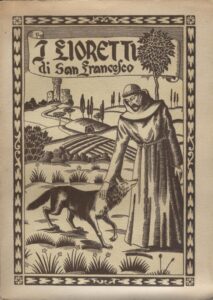
Returning to the Italian context, the poet Angiolo Silvio Novaro (1866–1938), who composed many poems for children—studied and memorised by more than one generation—celebrates episodes from Francesco’s life connected to the Wolf of Gubbio and the figure of the leper. Let us consider the poem dedicated to the Wolf:
Viveva un dì, narra un’antica voce,
intorno a Gubbio un lupo assai feroce
che aveva i denti più acuti che i mastini
e divorava uomini e bambini.
Dentro le mura piccole di Gubbio
stavano chiusi i cittadini e in dubbio
ciascuno della vita. La paura
non li lasciava uscire dalle mura.
E San Francesco venne a Gubbio, e intese
del lupo, delle stragi, delle offese;
ed ebbe un riso luminoso e fresco,
e disse: “O frati, incontro al lupo io esco!”.
Le donne avevano lacrime così
grosse, ma il Santo ilare e ardito uscì.
E a mezzo al bosco ritrovò il feroce
ispido lupo, e con amica voce
gli disse: “O lupo, mio fratello lupo,
perché mi guardi così ombroso e cupo?
Perché mi mostri quegli aguzzi denti?
Vieni un po’ qua, siedimi accosto, senti:
Io so che tu fai molto male a Gubbio
e tieni ognuno della vita in dubbio,
e so che rubi e uccidi e non perdoni
nemmeno ai bimbi, e mangi i tristi e i buoni:
Orbene, ascolta: come è vero il sole,
ciò che tu fai è male. Iddio non vuole!
Ma tu sei buono; e forse ti ha costretto
a ciò la fame. Ebbene, io ti prometto
che in Gubbio avrai d’ora in avanti il vitto:
ma tu prometti essere onesto e dritto
e non dare la minima molestia:
essere insomma una tranquilla bestia?
Prometti dunque tutto questo, di’?”.
Il lupo abbassò il capo, e fece: “Si!”.
“Davanti a Dio tu lo prometti?”. E in fede
il lupo alzò molto umilmente un piede.
Allora il Santo volse allegro il passo
a Gubbio, e il lupo dietro, a capo basso.
In Gubbio fu gran festa, immensi evviva:
scoppiò la gioia, e fino al ciel saliva.
E domestico il lupo entro rimase
le chiuse mura, e andava per le case
in mezzo ai bimbi come un vero agnello,
e leccava la gota a questo e a quello.
E poi morì. E fu da tutti pianto
e seppellito presso il campo santo.
Corrado Govoni (1884–1965) transforms Francesco’s preaching to the birds into poetry, widelicate and moving sensibility.
Tu sì che lo sapevi
perché sono felici gli uccelletti,
tutt’ali per volare e gole per cantare:
perché toccan la terra
soltanto per dormire e per morire.
Erano i tuoi fratelli tripudianti,
anch’essi mendicanti
che campan di minuzie
raccolte per le strade e nei cortili.
E con un cenno della mano
li radunavi tutti:
dai cespugli, vicino; dai boschi, lontano.
Allora ti volavan sulle spalle e sulla testa
e, beccandoti e tirandoti la tonaca,
ti facevano festa
senza sapere quello che volevi.
Poi si quietavano guardandoti
per ascoltare ciò che tu dicevi.
« Lodate sempre il nostro buon Signore!
Lo dovete lodare a tutte le ore!
Non sapete né filare né cucire:
v’ha dato un vestimento duplicato;
perché non seminate né mietete,
vi pasce; e vi dà i fiumi per bere,
e per i nidi gli alberi in fiore.
Lodato sempre sia nostro Signore!»
Gli uccelli rispondevano a gran voce,
e tu li benedivi e licenziavi
con un segno di croce.
Oh! quante volte ti fermasti ad
ammirarli lungo le siepi, sotto i pini,
affaccendati ad intrecciar le culle
di fuscelli, di bioccoli e di crini,
ed a covare zitti e segreti!
La tortorella, quand’era stanca
di stare con la pancia sopra l’uova
calde che tu; toccavi con un dito
per sentir muovere i pulcini,
usciva fuori a picchiare
il maschio, con piccoli gridi:
lo costringeva a far da mamma.
Quante volte parlasti con le rondini,
coi loro rondinini ancora ignudi
che facevano sporco fuor dei nidi!
In the realm of music, we have several examples: the Istrian-born singer-songwriter Sergio Endrigo (1933–2005), in his album “L’Arca“, which is also and primarily aimed at children, presents the track “San Francesco.” This piece features simple yet profound lyrics, accompanied by guitar and tambourine, with children’s choruses in the background. Saint Francis is portrayed in his poverty and his spirit of sharing with the poor, as well as his brotherhood with the natural elements, including fire.
Guarda San Francesco sul suo cammino
A piedi nudi, il poverino
Dorme la notte presso il mulino
Divide il pane col contadino
Guarda San Francesco che va bel bello
E non ha niente nel suo fardello
Saluta il vento “buon giorno amico!”
E dice al fuoco “sei mio fratello…”
Guarda San Francesco sul suo cammino
Che porta in braccio Gesù Cristino
Inventa giochi per il Bambino
Racconta favole all’uccellino
Guarda San Francesco sul suo cammino (si ripete dall’inizio).
In 1972, for the film Brother Sun, Sister Moon by Franco Zeffirelli, the singer-songwriter Claudio Baglioni (born 1951) composed, together with Ritz Ortolani and Father Benjamin, the eponymous track, which went on to achieve widespread success alongside the film:
Dolce è sentire come nel mio cuore
ora umilmente sta nascendo amore.
Dolce è capire che non son più solo
ma che son parte di una immensa vita
che generosa risplende intorno a me,
Dono di Lui, del Suo immenso amore.
Ci ha dato il cielo e le chiare stelle,
fratello sole e sorella luna,
la madre terra con frutti, prati e fiori,
il fuoco e il vento l’aria e l’acqua pura,
fonte di vita per le sue creature.
Dono di Lui, del Suo immenso amore.
Sia laudato, nostro Signore
che ha creato l’universo intero;
sia laudato, nostro Signore,
noi tutti siamo sue creature.
Dono di Lui, del Suo immenso amor.
Beato chi lo serve in umiltà.
Renzo Pezzani (1898–1951), a poet for children and elementary school teacher, subsequently provides, within the realm of lyrical poetry and nursery rhymes—an intersection between poetry and music—short yet impactful verses.
A muso a muso, dentro le tue mani,
si cibaron fidenti agnelli e lupi,
timide lepri e cani.
Dai suoi alti dirupi
calò il falco rapace,
e la tortora bianca, a lui vicino,
nel grembo tuo, Francesco, trovò pace.
Chi sete avea di sangue, e il cuore
dall’odio fatto di sasso,
cercò dietro il tuo passo
le briciole del tuo amore,
e poi che ne fu sazio,
alzò verso lo spazio
azzurro gli occhi, e ritrovò il Signore.