Among the sites that bear a special connection with the Saint of Assisi and the spread of Franciscanism in the Gubbio area, documentary sources mention the Convent of Santa Maria Assunta at Caprignone, the Abbey of San Verecondo at Vallingegno, the Leper Hospital at San Lazzaro, the church of Santa Maria della Vittoria, known as Vittorina, the monumental Church of San Francesco, and the small church of San Francesco della Pace. These locations are associated with numerous miraculous events performed by Francis, significant episodes of his journey from Assisi to Gubbio, and notable events that attest to the methods and timing of the dissemination of Franciscanism in Gubbio and its surroundings.
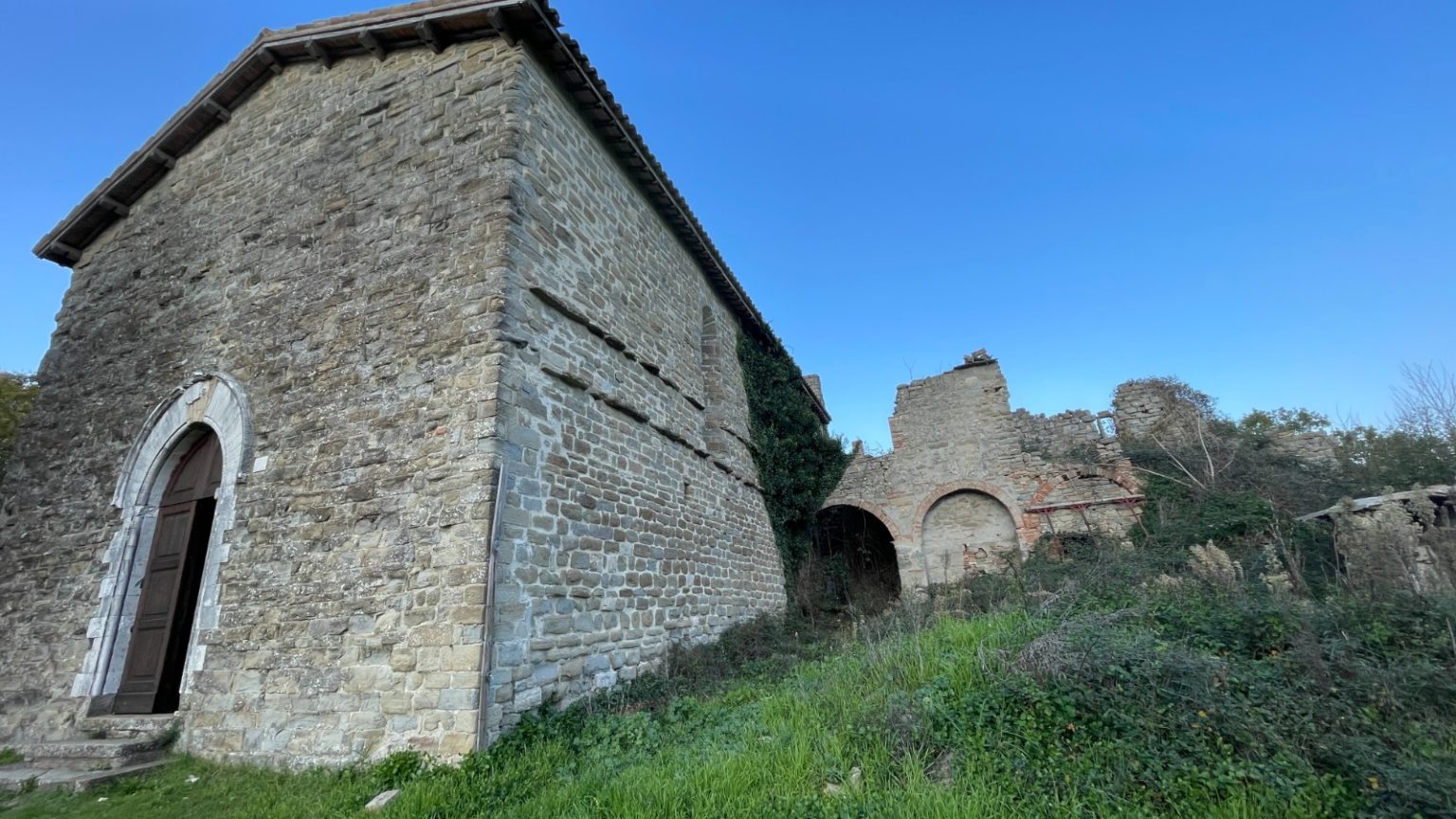
After his public conversion in Assisi, and guided by Providence, Francis found himself on the road to Gubbio. The first documented stop—recorded by the saint’s biographer, Tommaso da Celano—is near Caprignone, close to Biscina; here, he encountered robbers who mistreated him, throwing him into a snow pit after he presented himself as a herald of the Good God. This location is significant because it was here that the Count of Coccorano would later donate land to Francis, owing to their friendship, to build a convent. The Convent of Caprignone was created from the ruins of an ancient church dating back to the late 11th century, dedicated to the Virgin Assumed into Heaven, and possibly a pre-existing pagan temple. In 1223, it hosted the first chapter of the Franciscan Order convened outside Assisi, and friars Minor resided there until the final closure of the convent in 1653. Today, only the church remains, its struc structure reflecting the stylistic canons of mendicant architecture that emerged in central Italy. The architectural layout is very simple: a single nave with a quadrangular apse, a slightly elevated presbytery, a central window in the apse, and side windows along the nave; the nave and the apse area are separated by a triumphal arch reminiscent of the diaphragm arches typical of Cistercian-Burgundian tradition. The complex was situated along a major road frequented by travelers and pilgrims along the Chiascio River, and this strategic position, combined with the political landscape of the 13th century—domination first by Gubbio’s commune and later by Perugia—resulted in a cycle of artistic and cultural influences visible in the frescoes on the church walls (photo 1).
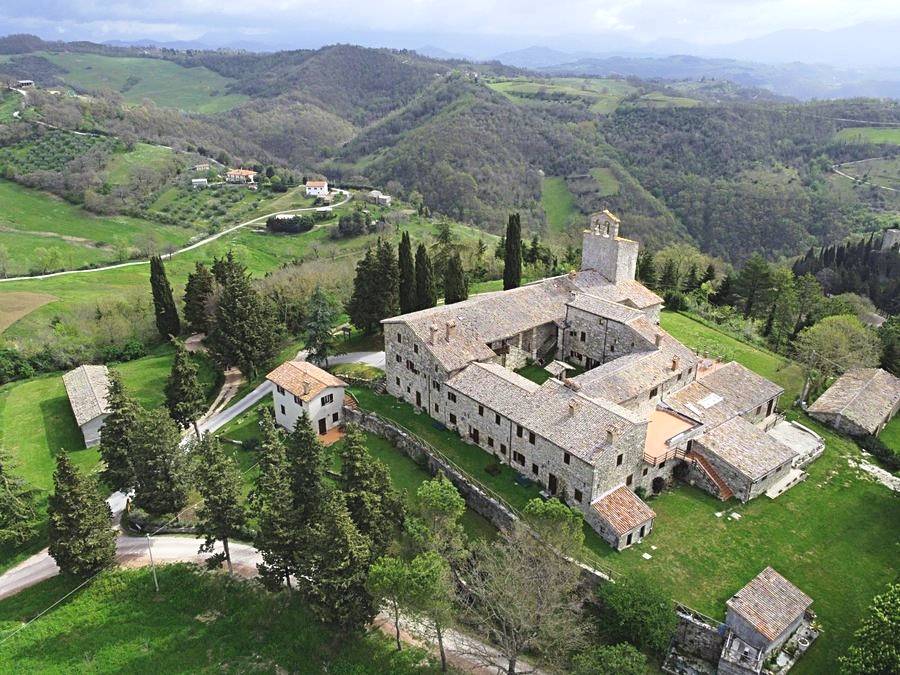
Following his assault by robbers at Caprignone, Francis sought refuge at the Abbey of San Verecondo in Spissis, on the Vallingegno hill. Here, where relics of the martyr Verecondo are preserved, he stayed for several days. Benedictine monks initially received him brusquely and with hostility, forcing him to perform hard kitchen chores. Only later, as his fame spread throughout the territory, did the prior apologise, and Francis was welcomed and hosted multiple times at the Abbey during his pilgrimages to La Verna. At this convent, Francis performed a miracle: moved by the death of a lamb bitten by a sow, he cursed the animal, which died after three days of suffering. The current complex of San Verecondo includes the church, the monastery, and a bell tower built on the remains of a tower wall. Inside the church, which has a single nave, traces of earlier structures can be found, especially in the square crypt supported by a central pillar that reinforces the cross vault; here, sculpted capitals in styles predating the 11th century are preserved (photo 2).
After his stay at San Verecondo, Francis arrived in Gubbio, welcomed by the Spadalonga family, who dressed him in the tunic that would become the symbol of the Order. In Gubbio, he dedicated himself entirely to caring for the lepers at the San Lazzaro hospital. Today, the San Lazzaro area is a suburban district of the city, with no remaining structures of the original hospital or church. Nonetheless, the historical memory of this site is important for understanding medieval life and the societal impact of disease. Medieval leper hospitals, or lazarets, were healthcare facilities dedicated to isolating and treating leprosy sufferers, located outside city walls to limit contagion. Gubbio’s leper hospital was situated strategically near the Camignano stream crossing, facilitating hygiene and treatments. Like elsewhere in Europe, the management of the lazaretto was entrusted to religious orders—specifically the Canons of the Cathedral—who provided care, refuge, and a sense of community amid widespread social stigma. The lazarets were largely self-sufficient, with agricultural and livestock activities to sustain the patients and religious personnel. After the decline of leprosy post-14th century, many lazarets were repurposed. The time Francis spent among the most needy marked a turning point in his full conversion. During his stay at San Lazzaro, he formed a close friendship with the Bishop of Gubbio, Beato Villano, which led to the granting of the church of Vittorina, located nearby, to the friars minor .
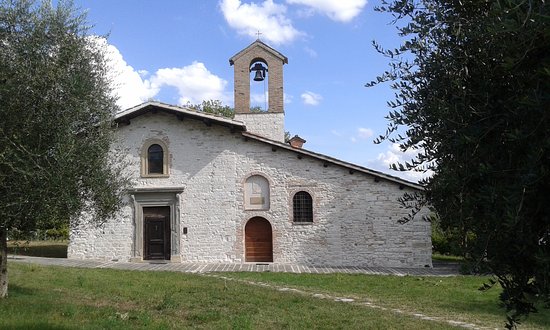
Tradition cites Vittorina as the first site where Franciscan friars settled in Gubbio. The original building, possibly from the 9th century, was constructed following a victory of the city over the Saracens, which may explain its name. In 1213, the small church was granted to Francis through the intercession of Bishop Beato Villano and with the approval of the Benedictine monks, its benefactors. The friars remained there until 1241, after which the structure was handed over to the Clarisse nuns. Situated just outside the city walls, Vittorina is also known as the “Porziuncola” of Gubbio; it is here that, according to the 21st Fioretto, the Seraphic Saint tamed a fierce wolf in 1220. No Franciscan sources mention Vittorina as the first Franciscan settlement in Gubbio—those documents supporting this hypothesis are all from after the 13th century—but its shape, size, and location still reflect the ideological preferences of the Order. The remaining original part is the apse, with a small Romanesque monofore that is now blind, adorned with two rosettes and a cross on the arch façade. The exterior presents a gabled structure built in limestone with terracotta inserts. The façade features a sandstone portal from the late 16th century, with a round-arched window above; flanking it are a blocked window and two plaques: one depicting a shield with a bas-relief of a Tau symbol and inscribed “Pax et Bonum 1226/1926,” and the other inscribed “Qui Francesco placò la perniciosa Lupa” (“Here Francis calmed the pernicious wolf”).
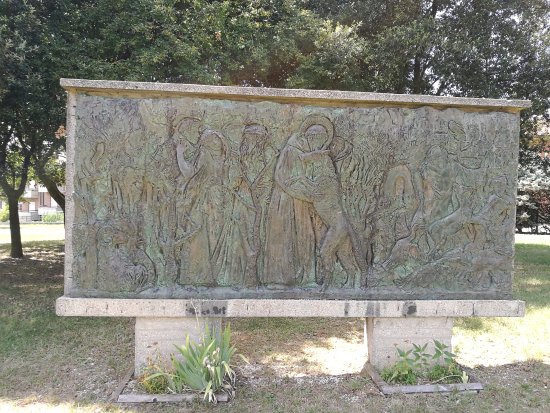
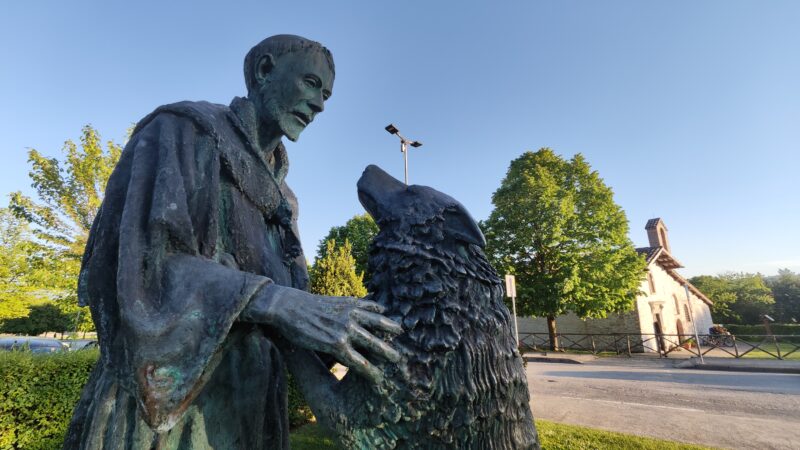
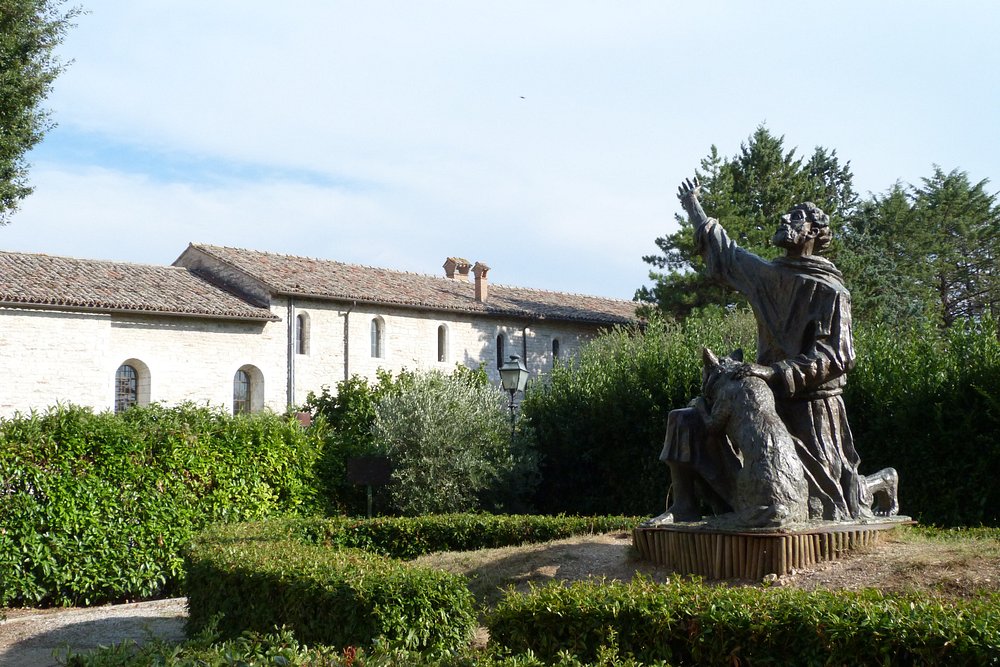
The current bell tower, built between 1934 and 1936 and located on the right wall, replaces the previous one, which was set further back between the high altar and sacristy. Since 1973 and in subsequent years, the area around the church has been revitalised with a large park called the Park of Vittorina or of Reconciliation—a place where nature, art, and symbolism coexist harmoniously. Inside the park, there are several commemorative works related to Francis’s encounter with the wolf: a bronze panel by Farpi Vignoli titled “Monument of Saint Francis and the Wolf” (1976), and an outdoor bronze sculpture by Francesco Scalici, “San Francesco e il lupo,” installed in 2002 (photo 4).
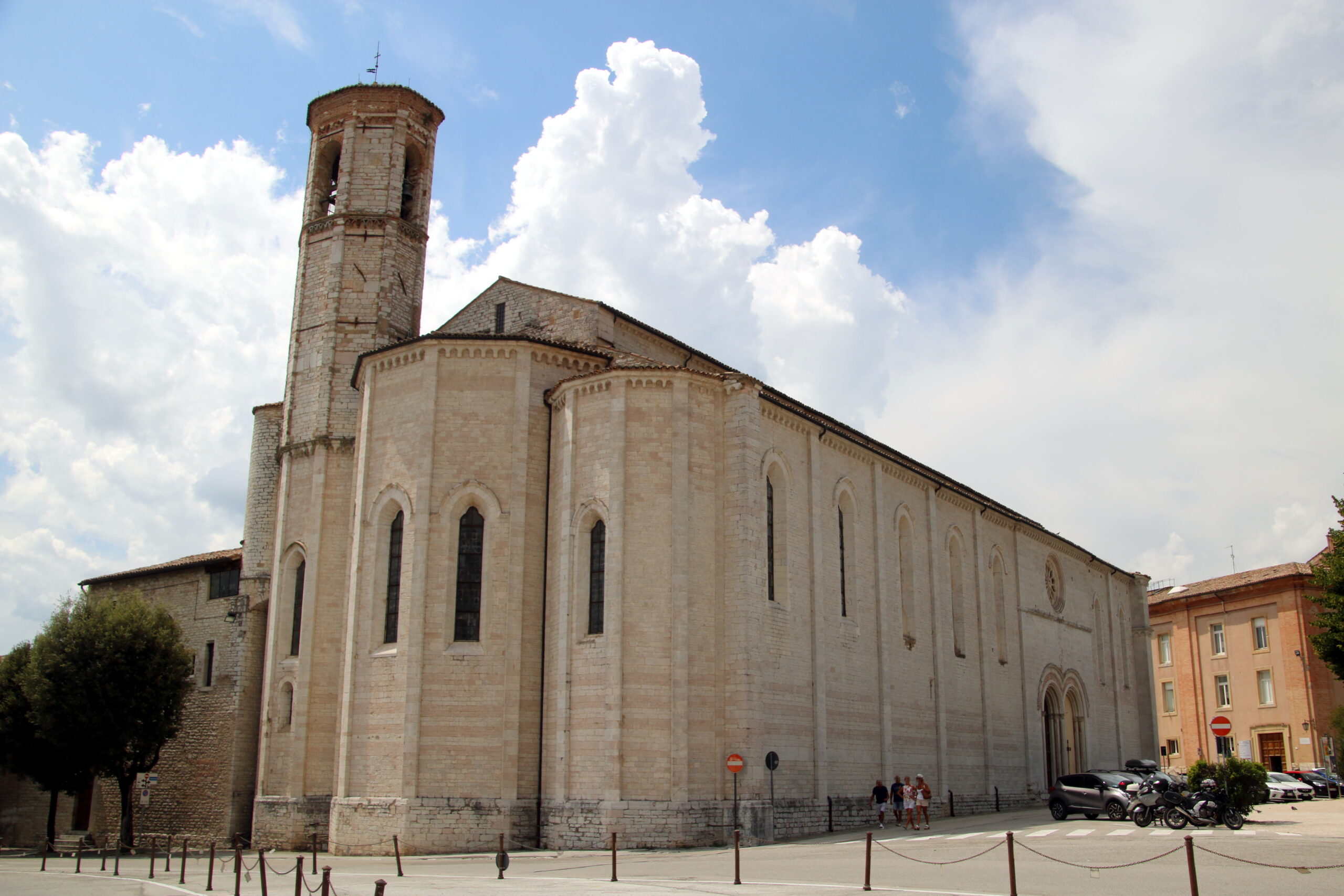
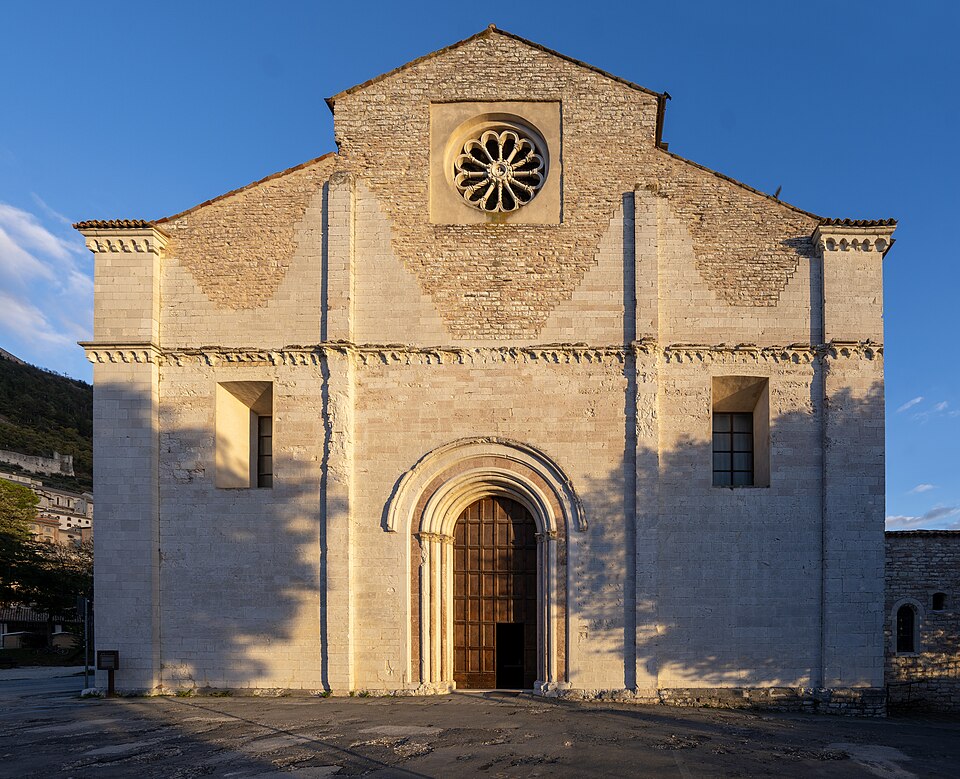
The construction of a large church and convent dedicated to Francis shortly after his death was strongly supported by the city of Gubbio. In 1241, the friars left Vittorina to move to the new convent and the monumental church in what is today Piazza Quaranta Martiri, formerly known as Piazza Mercatali—the heart of the city centre with significant historical importance. The Church of San Francesco (see photo 5), built in the second half of the 13th century, stands on part of the site where the residence and shop of the Eugubian Spadalonga family once stood; they were merchants of textiles and wool who welcomed, fed, and clothed Francis upon his arrival in Gubbio. Their hospitality was understandable: Bernardo Spadalonga had frequent commercial and friendly relations with Pietro Bernardone of Assisi—Francis’s father—and Francis himself had shared captivity in Perugia with Giacomello Spadalonga, Bernardo’s son, after the Battle of Collestrada in 1202. According to a papal bull by Pope Alexander IV, by 1256, the grand church of San Francesco was already in use, though not fully decorated by then. The architect responsible for its design, in a Gothic-Umbrian style, remains unknown. The façade (photo 6), unfinished, is simple yet elegant; it features a pointed Gothic portal and a large central rose window, in Romanesque style, derived from the church of San Francesco in Foligno. The original three polygonal apses are reinforced by corner buttresses and have monofore windows. The right apse hosts the polygonal bell tower built in the 16th century. Inside, the church has three high, spacious naves with cross vaults, dating from its reconstruction in 1720. Baroque altars were added in the 18th century, and some of the trilobed ogival windows were blocked—unfortunately, these modifications led to the loss of many wall paintings. The crypt beneath contains traces of older constructions and archaeological remains. The adjacent monastery, also from the mid-13th century, was considered the largest of its time, called the “Convent of the Hundred Cells.” Notable features include the cloisters, refectory, and chapter house, which contain interesting fresco fragments. The convent houses a rich collection of Franciscan art, including the ancient Seal of the Eugubian Custody (early 14th century), depicting Saint Francis and the wolf. Outside the church, in the square, stands a bronze statue approximately three metres high, representing Saint Francis and the tamed wolf, created by Eugubian sculptor Roberto Bellucci in 1997; this sculpture makes Saint Francis a symbol accessible and visible to the community (photo 7).
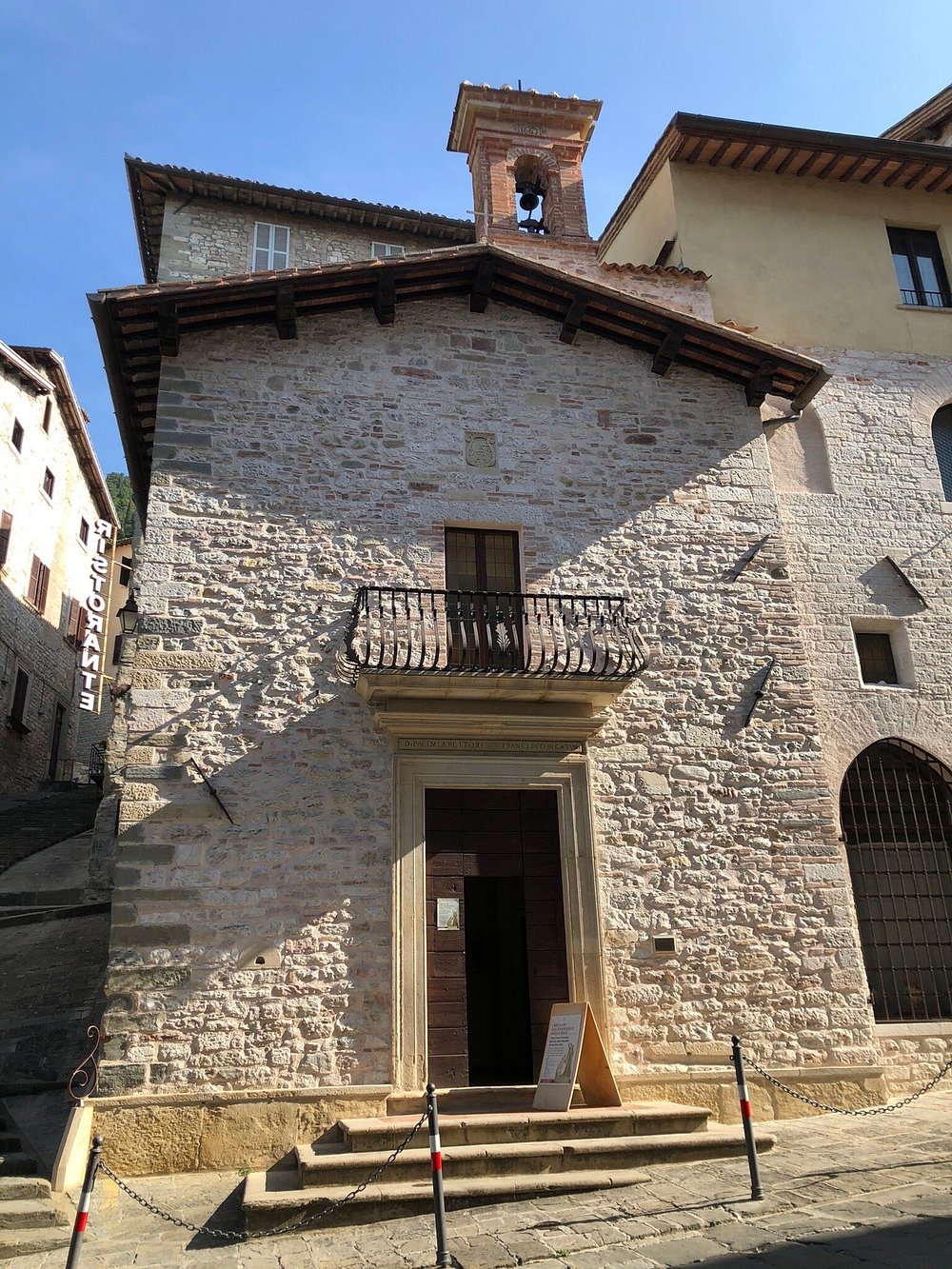
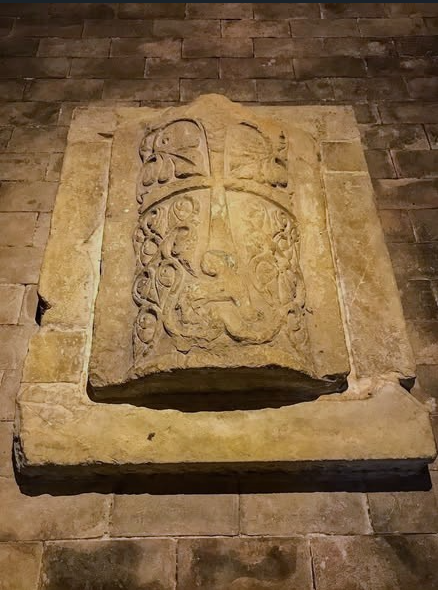
The Gubbio itinerary concludes with the church of San Francesco della Pace, uniquely bearing that name worldwide. Also known as the Church of the Masons, because it was the seat of the University of Masons, Stonemasons, and Allied Arts—the medieval guild of the Arte dei Petraioli, mentioned as early as the city statute of 1338. Located in the Sant’Andrea district, it stands in what was the Contrada di Morlupo in the 14th century. Its precise origin is uncertain, but it may be linked to the historical memory of the wolf or wolf’s lair. Documents show that as early as December 1503, the Gubbio City Council authorised the San Francesco monastery to build a chapel dedicated to the Poverello of Assisi in a place called “il fosso” (the ditch), along the route between Via Savelli della Porta and Via Baldassini, where the memory of the tame wolf’s death was preserved—specifically, above the cave where the animal lived for over two years, loved and cared for by the Eugubians until its death. However, this chapel was never built. In June 1618, the Gubbio municipality granted part of public land to the Masons’ Guild to enlarge the church then under construction in honour of San Francesco della Pace. Beyond the construction history, it is remarkable that, among all areas of Gubbio’s city centre, the same location—the ancient Contrada di Morlupo—was chosen over a century later to build initially a small chapel and then a church dedicated to the peace pact between Francis and the wolf. The portal’s lintel bears a carved figure of a lying wolf (possibly dead); inside, there is an altar believed to be the stone upon which Saint Francis delivered a sermon after taming the fierce beast. On the lower floor, a mid-evil cover of a sarcophagus, thought to be the tomb of the wolf, is embedded in the floor. In 1873, during street paving works along Via Savelli della Porta, just near the church, some masons found a well-crafted stone engraved with a cross, covering a small sarcophagus containing, according to the municipal veterinarian Giovanni Spinaci, a canine skeleton. A 1927 report by Father Ugolino Paris OFM in the journal “Studi Francescani” recounts four testimonies about these events, given to Father Emidio Selvaggi OFM, then custodian of the Basilica of Sant’Ubaldo. The skull, at least 25 cm long, was kept in a local workshop but was accidentally shattered; over time, the remaining skeletal fragments were dispersed. Consequently, there remains no definitive evidence about the cave, the tomb, or the remains of the wolf or wolf’s lair in Gubbio. Further research could significantly advance our understanding of the relationships – of various kinds – that the Franciscan story had with the city of Gubbio.