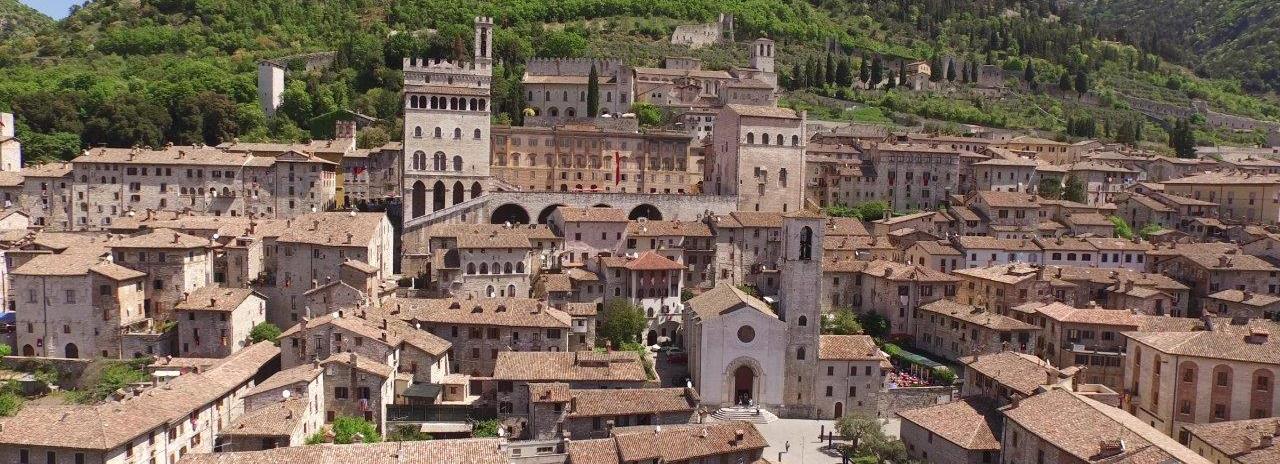
The human and spiritual story of Saint Francis of Assisi is profoundly intertwined with the city of Gubbio, long regarded as the city of his rebirth. It was here that Francis arrived in the early years of the thirteenth century, after renouncing his family wealth, as a new man who wished to live in poverty among the least of society. Francis’s presence in Gubbio—where he stayed several times between 1207 and 1222—coincided with the recent transfer of Saint Ubaldo’s body to Mount Ingino, a time marked by deep spiritual fervour and intense pilgrimages in honour of the city’s beloved patron saint. These were also the years of the pastoral activity of Bishop Villano, whose ministry was centred on charity and support for the poor, on the values of peace and reconciliation among men, and on the reform of the clergy, whose communal life he actively encouraged. But what was Gubbio like in the age of Francis? What urban, political, social and economic changes defined it during the thirteenth century? At that time Gubbio—then called Agobbio—was a Free Commune with a predominantly pro-imperial, and therefore Ghibelline, orientation. It exercised jurisdiction over a large territory of more than 800 square kilometres, at the heart of one of the most important economic and cultural crossroads of medieval Italy. Its territory bordered, within Umbria, on the lands of Nocera, Città di Castello, Perugia and Assisi, extending north-east of the Apennines into what is now the Marche region, along a corridor stretching from Cagli to Pergola and Montesecco—just a few kilometres from the Adriatic coast and its ports. A dense network of castles and monastic settlements (most notably that of Santa Croce di Fonte Avellana on Mount Catria) guarded this territory, which throughout the thirteenth century was often involved in conflicts with neighbouring communes. The most unstable frontier was that with Perugia, a staunchly papal, hence Guelph, city, which sought to expand its domains into Gubbio’s territory through two major military campaigns, in 1216–1217 and 1257–1259. By the 1260s, however, the political landscape changed dramatically. The collapse of the Swabian presence in Italy and the so-called Angevin turn in the South, promoted by Popes Urban IV and Clement IV, weakened the imperial faction and ended the possibility of an alternative power. Gubbio, too, eventually aligned itself with the Church, becoming Guelph. The thirteenth century was also a period of evolution in the communal system. In Gubbio, as elsewhere, the consular government was gradually joined, first, by the office of the podestà (in the early thirteenth century) and later by that of the captain of the people (by mid-century). The podestà, usually a nobleman from another city, exercised executive authority, convened councils and administered justice. He was less a political leader than a salaried magistrate appointed for a limited term, meant to stand above local rivalries. The captain of the people, also often of noble birth, assisted him in the exercise of executive power and in convening the councils. In judicial matters he held appellate jurisdiction over the podestà’s sentences, acting as defender of the people and of the emerging social classes of artisans and merchants who, in the fourteenth century, would become key figures in the era of popular government. The municipal territory alternated between plains, hills and mountains, crossed by substantial watercourses such as the Camignano, the Cavarello, the Saonda, the Assino and the Chiascio, which traversed the planum, or basin, overlooked by medieval Gubbio. Along these rivers, various economic activities flourished, powered by water mills. The production of woollen cloth and leatherworking were the two most dynamic sectors of the local economy. Much of the raw material—wool, cotton, linen and hides—arrived through the Adriatic ports or the Tuscan markets of Florence, Pisa and Siena. Masonry, blacksmithing and carpentry also thrived. In the thirteenth century, medieval Gubbio was very much a city under construction and continual transformation. Changing needs of the main secular and religious institutions, as well as rapid demographic growth, called for larger and more suitable buildings. In the first half of the century, the urban space was still divided between an upper and a lower part. On the slopes of Mount Ingino, above a steep escarpment where the Ducal Palace would later rise in the fifteenth century, stood the platea communis, with the Town Hall, the new Cathedral and the Canonica of San Mariano. The oldest core of the Town Hall, overlooking the communal square, was expanded with the addition of a great vaulted structure that supported the spacious council chamber, lit by numerous pointed windows with a view of the plain below. At the centre of the square stood the Fountain of the Arengo, later transferred to the Palazzo dei Consoli, which became the new seat of the communal government in the fourteenth century. The escarpment, together with a row of buildings and defensive walls, protected this strategic nucleus of both civic and ecclesiastical power. Below the escarpment lay several older residential clusters or vici, developed in previous centuries. This area would later become, in the first half of the fourteenth century, the site for new public buildings and for the construction of the great Piazza Grande. The vicus Ultra Aquam was an aristocratic, feudal settlement that had developed between the ninth and twelfth centuries on the right bank of the Camignano River, at the entrance to the Bottaccione Gorge. Separated from the rest of the city by the river, it expanded during the thirteenth century to become part of the quarter of San Martino, still the most ancient and characteristically medieval section of Gubbio, with its teardrop-shaped plan, winding streets and noble tower-houses aligned with smaller dwellings. The vicus Platee was the principal meeting and trading place of early medieval Gubbio. The settlement had grown around the church and canonry of San Mariano, seat of the first Eugubine bishopric. When the episcopal seat was moved to the slopes of Mount Ingino between the late twelfth and early thirteenth centuries, the area became home, in the first half of the thirteenth century, to the church of San Giovanni. Bounded to the south by the Camignano River, this district had a strong popular character, inhabited largely by craftsmen engaged in the many trades dependent on water power. The area’s street names still testify to these activities: Via delle Conce (Tanners’ Street), Via dei Battilana (Cloth-Beaters’ Street), and Via dell’Abbondanza (Abundance Street), where the grain mills once stood. The large open space now known as Piazza Quaranta Martiri—today mostly occupied by public gardens—was in the thirteenth century the campus mercatalis, a broad, unpaved market area for live animals, then outside the city walls. Near this market lay properties owned by the Spadalonga family, including one of the city’s most important warehouses. The Spadalongas traded in woollen cloth, and it was to them that Francis turned upon his arrival from Assisi, seeking hospitality and support. Federico, son of Giacomello Spadalonga, had befriended Francis years earlier during their imprisonment in Perugia, and it was he who gave Francis the grey bigello tunic that later became the habit of the Franciscans. The family also donated the land on which the church of San Francesco was built in the mid-thirteenth century. In the latter half of the century, with renewed population growth fostered by the political stability of the Guelph communal government, the city expanded downhill, particularly to the southeast. This area, previously an enclosed agricultural zone of gentle slopes planted with vineyards and orchards belonging to the ancient abbey of San Pietro, developed into a new residential quarter as agricultural lands were subdivided to accommodate the emerging artisan classes. The symmetrical, regular layout of today’s San Pietro quarter still reflects that phase of economic and social growth experienced by Gubbio in the thirteenth century. The abbey of San Pietro’s properties extended across the surrounding countryside and included the small church of Santa Maria della Vittoria. Built after 853 to commemorate a victory of the Eugubines over the Saracens, this church was granted by the Benedictines and Bishop Villano to Francis and his companions, becoming the first settlement of the Friars Minor in the Gubbio territory. It was here that Francis tamed the wolf of Gubbio and, at the nearby hospital of San Lazzaro—owned by the diocesan curia—he cared for lepers. Leprosy, present in Europe and the Mediterranean since the sixth century, remained a serious disease until the fourteenth century. Medieval cities protected themselves through health policies that required leper hospitals (lebbrosari) to be built outside the city walls. In the Middle Ages, the term leprosy encompassed not only the bacterial disease itself but also various visible and disfiguring skin infections. As the illness had a long incubation period—five to ten years—prevention consisted mainly of isolating the sick in dedicated hospitals. Leprosy evoked both individual and collective fear, disgust and rejection, seen as divine punishment for human sin; yet at the same time it inspired an opposite conception in which suffering was viewed as a path to salvation. The leper thus came to embody the suffering Christ, and care for the sick acquired deep religious significance. Medieval hospitals were often administered by confraternities—lay associations devoted to charity and assistance—which, from the thirteenth century onwards, became an essential part of urban life, alongside churches and mendicant convents. The establishment of Franciscan, Dominican and Augustinian houses on the city’s outskirts in the mid-thirteenth century led to the construction of a new and larger circuit of walls, and to the emergence of a new urban structure arranged like a cross of churches, with the parish church of San Giovanni at its centre—the true focal point of the walled city. The urban space, previously divided into seven vici, was reorganised into four quarters: two on the upper slopes (Sant’Andrea and San Giuliano) and two below (San Martino and San Pietro). Each quarter was further divided into contrade, connected by trivio spaces—small squares formed by the meeting of three streets, serving as hubs of social life where people gathered for trade or assembled under their banners in times of need. Other meeting places included churches, palaces, bridges, fountains and gates. Still visible today, to the north-east of the city between Mounts Foce and Ingino, is the medieval aqueduct begun in the mid-thirteenth century. It linked the city to an artificial reservoir at the foot of Mount Foce, following a route along the western slopes of Mount Ingino. The waters channelled into the city fed both the two rivers—the Camignano and the Cavarello—serving the needs of manufacturing activities requiring water power, and a series of public fountains in the city’s quarters for daily use. In the Middle Ages, Gubbio also distinguished itself as one of the most significant centres of the visual arts. Its central position in the Apennines fostered multiple contacts, making it both a recipient and a source of artistic traditions and innovations. Alongside daring architects flourished generations of master stonemasons, woodcarvers, painters and illuminators. It was Dante Alighieri who fixed Gubbio’s place in the history of Italian art. In the Divine Comedy, as he ascends the slopes of Purgatory among the proud, he meets Oderisi, “the honour of Gubbio,” a master illuminator renowned for his skill in the art of miniature painting. Oderisi and his father, Guido di Pietro da Gubbio, were both accomplished painters active in Umbria and Bologna during the mid-thirteenth century.