
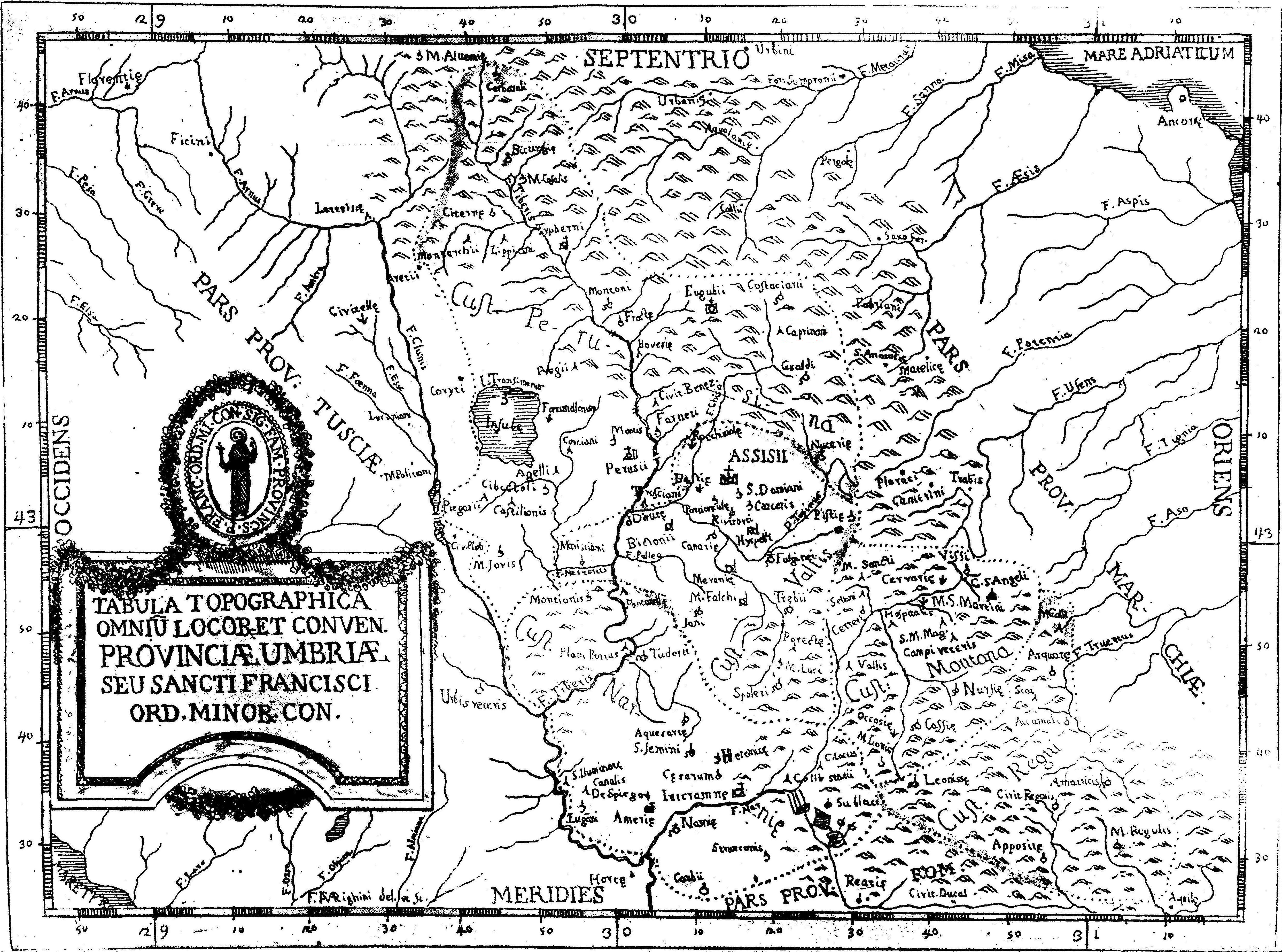
The phenomenon of the Franciscan movement began to emerge in Europe between 1207 and 1209, receiving its first papal approval in 1210. It was of such significance that it transformed much of the religious, social, economic, and political life of the known world at that time; the ideas embodied by Saint Francis challenged a socio-religious system that had lost sight of the true meaning of “poverty,” a principle always inherent in the Christian message. This led to the development of a new value system through which every aspect of social and religious life was reinterpreted, and which the friars transmitted throughout Italy and beyond. The “new system” also influenced the way they established themselves within territories, conceiving their presence as an integral part of the urban fabric. Initially, the earliest Franciscan settlements appeared in areas rejected by the city and located outside the urban walls, where the friars ministered to marginalised populations. These initial settlements consisted of pre-existing structures or small, dilapidated buildings, in accordance with the Rule of Saint Francis; over time, they grew in importance, quality, and size, paralleling the increasing stature of the Order itself. Throughout the 13th century, Franciscan sites were both urban and rural: the urban ones were situated near centres with a predominantly mercantile and artisanal economy or administrative and political hubs, while the rural settlements operated in agricultural areas, often distant from populated centres. Some served as “romitori,” isolated hermitages located in mountains or wooded areas where the friars withdrew for prayer, meditation, and to live in poverty, following the Franciscan ideal of proximity to nature and contemplation. All settlements, as noted, were primarily located within existing churches, houses, or structures; they could remain the property of the benefactors or private donors, passing into the friars’ usufruct, or were built anew by the friars themselves, only nominally owned by third parties. The earliest documentary evidence of these settlements comes from notarial acts, though these are considered late, as they appear after the settlements had already been established. Local tradition, however, bears witness to the initial settlement of friars in a given area, though establishing the precise origin and historical veracity is often difficult. Some traditions trace the foundation back to Saint Francis’s passing or to donations of churches, houses, or land accepted by the saint. Considering the complexities of reconstructing the chronology of Francis’s travels, it can be affirmed that stories of the friar’s stops or those of other prominent early Franciscans, even when not strictly documentary, serve as valuable testimonies that the friars did indeed follow specific itineraries. Examining the year 1230, when Saint Francis’s body was translated to the new Basilica of Assisi, as a terminus “ad quem” for studying the phenomena of Franciscan settlement, and considering 190 settlements scattered across regions of Italy (Abruzzo, Emilia-Romagna, Calabria, Lazio, Lombardy, Molise, Tuscany, Umbria, Veneto, as well as some sites in Istria and Dalmatia), it is evident that over 120 (roughly 70%) of these were already founded and operational by 1230; of these, about 100 (approximately 55%) are believed to have been established during Saint Francis’s lifetime. Of this latter group, approximately 70-75% had an urban character. Hence, after the initial period characterised by the absence of permanent residences, there was a marked increase in settlements, primarily urban. The two types of settlements—urban and rural—developed roughly in parallel chronologically; however, a clear tendency emerged for the Order to focus its evangelising efforts in urban centres, leading to a numerical dominance of the former over the latter. A geographical analysis of the distribution (see fig. 1) reveals that these settlements clustered along major routes of communication, spaced about a day’s journey apart. How they arrived at such a rational spatial organisation is difficult to determine, but the map indicates that in central Italy—the region of earliest Franciscan diffusion—the pattern appears spontaneous, with settlements emerging almost incidentally in both urban centres and along major roads or in more isolated areas. Conversely, moving northward from central Italy, the distribution becomes more ordered, with settlements serving as waypoints along well-defined itineraries. This pattern correlates with the friars’ apostolic missions in foreign lands, which aimed to establish their first residences in towns located along major transit routes. Practical considerations of travel led to a geographical planning of the settlements, favouring urban centres and principal routes. This planning was facilitated by the presence of pre-existing structures, including some hermitages that were incorporated into the network, especially in Umbria and surrounding areas. After 1230, however, there was a significant decline in the number of new settlements: from the 190 examined, only about a dozen were founded in the decade 1230–1240, with even fewer later on. This decrease did not reflect a reduction in the number of postulants; on the contrary, the figure remained substantial enough to force the Order’s leadership to impose more rigorous selection processes. The reduction in new settlements was primarily due to the increasing concentration of friars in urban areas, where demand for apostolic service was higher, resources more abundant and accessible, security better guaranteed, and recruitment more numerous, socially and culturally prestigious. This shift towards urban centres is closely linked to the realignment and expansion of urban settlements, necessitated by the need to transfer or enlarge existing sites. This situation was contrary to Saint Francis’s original vision, and even the newly elected General of the Order, Bonaventure of Bagnoregio, expressed concern. In his first official epistles, he explicitly sought to curb this trend, issuing precise instructions to keep the growth within limits consistent with the vow of poverty. Nonetheless, between 1257 and 1280, the situation spiralled out of control: some rural settlements and hermitages were relocated closer to cities, incorporated within city walls, and in some cases abandoned altogether. This appears to be a form of escape from economic and social insecurity. During this period, few rural settlements survived, and even fewer emerged anew; organisationally, due to their small size and limited number of friars, these were generally incorporated into the jurisdiction of nearby urban settlements. Although the Order’s leadership endeavoured to safeguard the existence of small rural centres, the most significant institutional transformation was the growth of urban settlements, which increasingly became autonomous entities separate from the local ecclesiastical hierarchy, often seen as rivals by the latter. The papal bull issued by Gregory IX in 1240 had already mandated that the friars move within the city walls, thus involving them in the process of urbanisation that would radically alter their initial settlement practices. This period also saw the beginning of internal divisions within the Order: the “Observants,” who strictly adhered to the original Rule, and the “Conventuals,” who sought to adapt their way of life to more cenobitic, organised communities. These two tendencies were already evident at Assisi, where, following the death and canonisation of Saint Francis, the two most emblematic sites of Franciscan life were established: the Sacro Convento, housing the saint’s tomb and controlled by the Conventuals, and the Porziuncola, the official seat of the Order and the Observants. The Conventuals developed an independent typological system rooted mainly in rural Umbrian architecture and Benedictine traditions more broadly. These structures were unified entities, with a coherent logic and design—church and convent integrated into a single system, with the cloister serving as an organisational unit, almost like an expandable module. The Franciscan conventual style of building, along with that of other mendicant orders such as the Dominicans and Augustinians, was characterised by an emphasis on modesty, simplicity, and decorous poverty. During the 1260 Chapter of Narbonne, the regulations drafted at the 1239 General Chapter in Rome were reaffirmed, revised, and completed under the authoritative guidance of Bonaventure of Bagnoregio, who served as Minister General from 1257 to 1274 and is regarded as almost a second founder of the Order. These regulations were codified in a comprehensive legal body known as the Constitutions of Narbonne. Frequently updated and enriched with additional statutes and capitular acts, the Narbonne Constitutions reflected the evolving phases of the Order’s history, especially in its early centuries. The norms established during this chapter were particularly strict regarding construction: the statutes strictly regulated the size and height of churches and convents—prohibiting excessive length, width, and height—and forbade ornate furnishings. Churches were to have no vaults except for the main chapel; decorations with paintings and stained glass were precisely prescribed; and bell towers resembling towers were forbidden. These regulations aimed to control the rapid and uncontrolled proliferation of churches initiated around 1240. However, the construction of the basilica-memorial of Saint Francis in Assisi (the lower basilica built between 1228 and 1230, and the upper basilica consecrated in 1253) marked a turning point, as diverse types of churches—ranging from simple single-aisle structures with wooden roofs to large cathedrals—began to emerge. It was already too late for strict normative control, as practical needs soon took precedence over regulations. This construction boom can also be viewed from another perspective: the friars often sought to emulate, and even surpass, existing Dominican convents in many centres by planning ever more monumental churches. Despite the uncontrolled growth of this trend, a minority within the Order continued to contest these developments, advocating for adherence to Saint Francis’s principles of poverty and simplicity.