The Little Flowers of Saint Francis (I Fioretti di San Francesco) is a collection of episodes and miracles from the life of the Poor Man of Assisi and his first companions—Brother Leo, Brother Masseo, Brother Juniper, and Brother Giles. It is not a biography in the strict sense but a hagiographic work: a religious narrative written in a simple, poetic language, intended to inspire and edify readers through examples of faith, humility, and love for one’s neighbour and for creation. Composed in vernacular Tuscan during the fourteenth century—around a hundred years after the saint’s death in 1226—the work’s author remains anonymous. However, most scholars attribute it either to Friar Ugolino of Montegiorgio or to Friar Ugolino of Santa Maria in Monte, both Franciscans. The Fioretti consist of fifty-three main chapters, followed by a section entitled The Ten Chapters and a concluding part known as The Considerations on the Stigmata.
The collection highlights key Franciscan virtues:
- Evangelical poverty
- Spiritual joy
- Love for nature and all creatures
- Humility and obedience
- Fraternity with all living beings
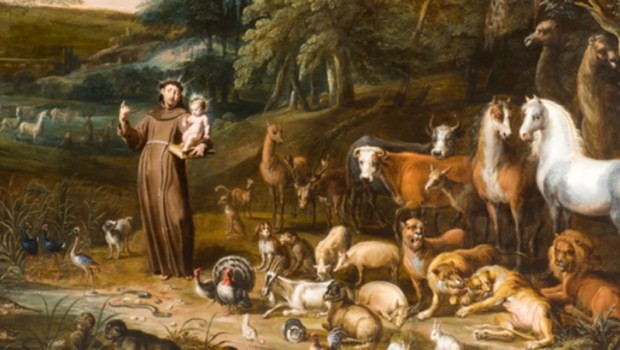
The language is straightforward yet filled with poetic imagery and symbolism—often humorous, but always profound in its spiritual depth. One of the most fascinating and significant aspects of the text is its use of animal symbolism, which reflects not only Francis’s love and respect for every creature but also a spiritual vision of the world. In this vision, animals become signs of God’s presence, instruments of divine communication, and mirrors of Gospel virtues. Saint Francis did not see animals as mere lower beings but as “brothers” and “sisters” within the great design of the Creator. Every creature, in his Franciscan outlook, has a sacred role and speaks of God. In the Fioretti, the saint’s many encounters with animals carry symbolic and moral meaning. Each animal possesses a symbolic soul—it does not speak with a human voice but conveys a spiritual truth. Francis listens to them, welcomes them, and protects them.
🐺 The Wolf of Gubbio – A Symbol of Conversion and Reconciliation: A ferocious wolf terrorised the people of Gubbio. Francis, with gentle authority, spoke to it and persuaded it to cease its violence, turning it into a friend of the townsfolk. Symbolism:
- The wolf represents ferocity, sin, and fear.
- Its conversion symbolises inner transformation through love and dialogue.
- The peace between man and nature reflects the Gospel’s call to reconciliation between enemies and those who are different.
🕊️ The Birds – A Symbol of Innocence, Freedom, and Harmony with God: Francis preached to the birds, who listened silently and reverently. He called them brothers and praised their freedom and trust in Divine Providence. Symbolism:
- The birds embody the Gospel ideal of poverty and trust in God.
- They represent pure and simple souls, open to the Divine Word.
- They symbolise spiritual freedom—souls that soar towards God, unburdened by worldly ties.
🐑 The Lamb – A Symbol of Gentleness and Holiness: Francis received a lamb as a gift, which followed him everywhere. When he prayed, the lamb stopped quietly, as though understanding the sacredness of the moment. Symbolism:
- The lamb represents the meekness of Christ, the Lamb of God.
- It symbolises purity and loving submission to the divine will.
- It expresses the deep communion between the holy man and creation.
🐠 The Fish – A Symbol of Spiritual Life and Christian Community: Francis saved a fish caught in a net, blessed it, and released it. The fish stayed near him until he gently told it to return to the water. Symbolism:
- The fish is an ancient Christian symbol (ICHTHYS = “Jesus Christ, Son of God, Saviour”).
- It represents faith, baptism (water), and life hidden in God.
- It shows the gratitude of redeemed nature.
🐴 The Donkey – A Symbol of Humility and Patience: Although not directly present in the Fioretti, other Franciscan stories speak of Francis’s respect for the donkey—an animal humble and patient by nature. Symbolism:
- The donkey symbolises humility, endurance, and silent fidelity.
- It embodies the simple, poor man beloved of God.
🐦 The Blackbird – A Symbol of Temptation and Discernment: (In a lesser-known Fioretto) One day, as Francis prayed, a blackbird began to sing nearby, distracting him. Realising the subtle temptation, he gently drove it away. Symbolism:
- The blackbird represents temptation disguised as beauty or distraction.
- It shows that even innocent-seeming things can lead us away from God.
- Francis’s response teaches spiritual discernment and self-mastery.
🐍 The Serpent – A Symbol of Evil but also of Spiritual Vigilance: (In related Franciscan legends) During a hermitage retreat, a serpent approached Francis’s cell but withdrew without harming him. Francis had met it with peace and prayer. Symbolism:
- The serpent traditionally symbolises the devil or danger.
- Its harmless retreat demonstrates spiritual strength overcoming evil through peace.
- It teaches that one who dwells in God need fear nothing in nature or in evil.
🐝 The Bees – A Symbol of Community and Good Work: (In the accounts of his companions) Francis praised the bees for their orderly and useful work, calling them “humble servants of God” for their diligence. Symbolism:
- The bees represent well-ordered communal life and cooperation.
- They symbolise the sweetness of the Gospel (honey) and quiet, fruitful labour.
- They invite believers to live fraternally and work without vanity.
🐐 The Friar’s Little Goat – A Symbol of Compassion and Care for the Lowly: A friar had a small goat that kept him company and helped him in his tasks. When it died, the friar grieved, and Francis consoled him, praising his tenderness towards the small creature. Symbolism:
- The little goat represents the humble and weak, those who give simple love.
- It teaches that Christian compassion must extend even to the smallest beings.
- It reminds us to be gentle and grateful, not hard-hearted, even towards animals.
🦅 The Eagle – A Symbol of Contemplation and Divine Majesty. (In the Legenda Perugina, a source parallel to the Fioretti) During solitary prayer, an eagle hovered silently above Francis, as if in adoration. He recognised in it a sign of God’s presence. Symbolism:
- The eagle symbolises contemplation and the soul’s far-seeing vision.
- It represents the link between heaven and earth.
- It is the image of the soul that rises fearlessly towards God.
🦢 The Goose and the Swan – Symbols of Divine Beauty and Gentleness: (In minor sources) Some stories tell of Francis rescuing geese or pausing to admire swans. He praised their simple beauty and the harmony of creation. Symbolism:
- The goose and the swan represent nature’s beauty as a reflection of the Creator.
- They symbolise grace, peace, and the poetry of the redeemed world.